
App Store Rejection Reasons: Apple’s 2025 Numbers
App Store rejection reasons from Apple's 2025 data: 2.09 million of 9.1 million submissions rejected. Here is how to pass Apple App Review the first time.

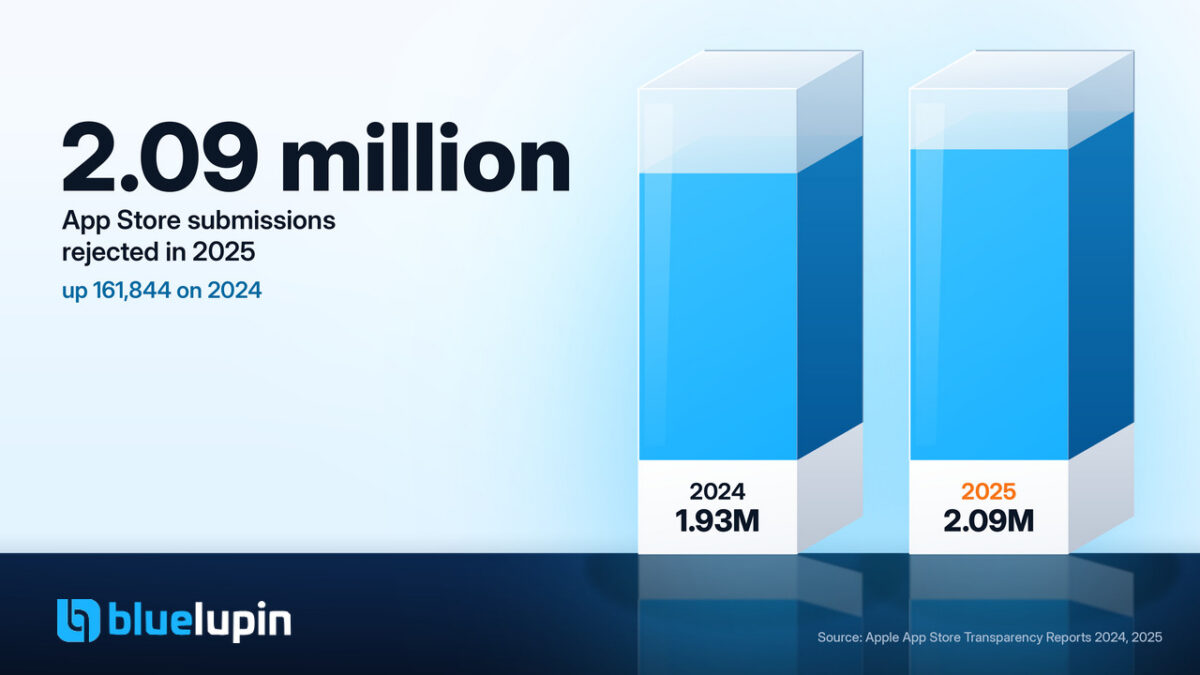
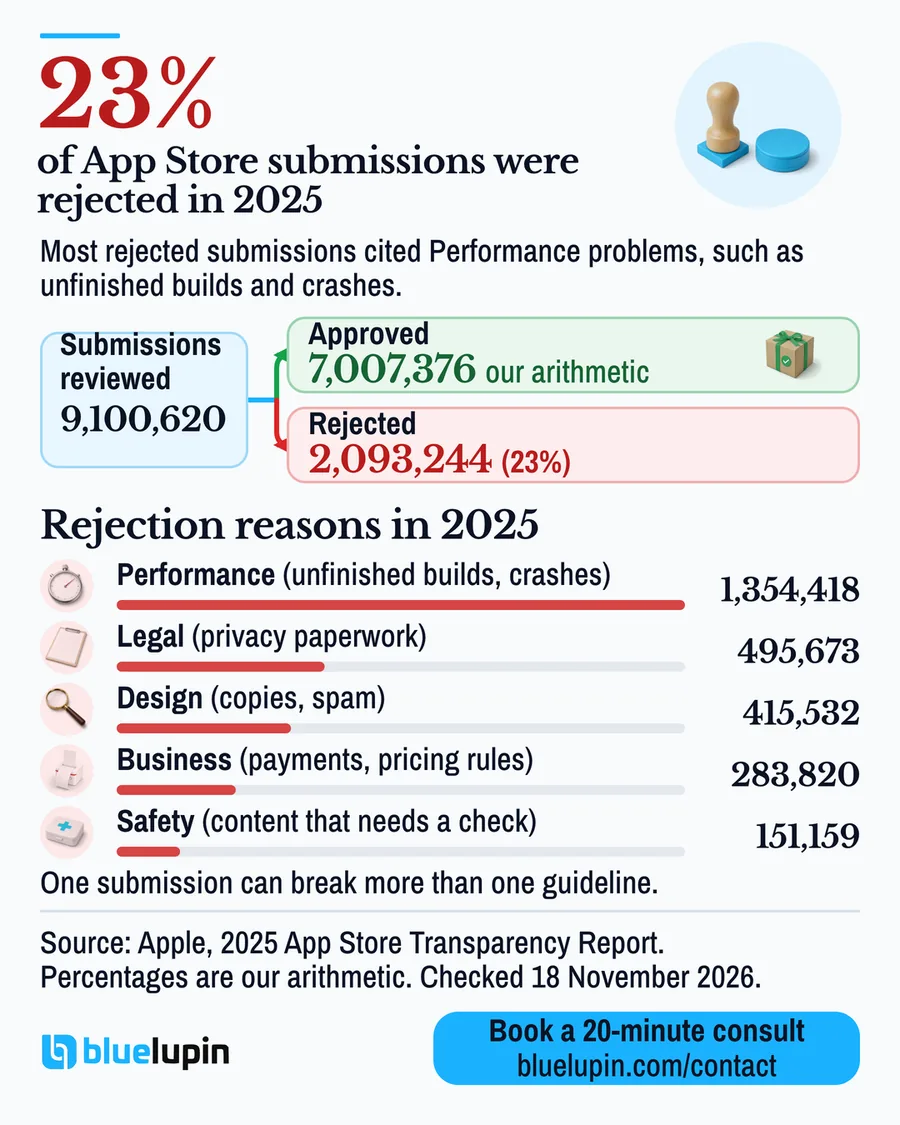
Apple rejected 2,093,244 of the 9,100,620 app submissions it reviewed in 2025, about 23% by our arithmetic. Most rejections cited its Performance guidelines, which cover crashes, unfinished builds and missing demo access. To pass App Review the first time, submit a complete, tested build with working login details, accurate metadata and a clear privacy policy.
We went through Apple’s own numbers to see which App Store rejection reasons come up most, and what to check before you press Submit.
Checked 24 November 2026.
What Apple’s 2025 report says about rejections
Apple’s 2025 App Store Transparency Report says it reviewed 9,100,620 submissions and rejected 2,093,244. Later, 387,087 rejected submissions were approved after changes, 18.5% of rejections by our arithmetic.
Apple’s footnote says apps “may be submitted to App Review multiple times before they are approved for release on the App Store.” A submission can be a new app, update or resubmission, so 23% is the share of review attempts that failed. Apple’s newsroom post of 20 May 2026 puts the rejections at “over 1.2 million new apps and nearly 800,000 app updates”.
Against the 2024 report, submissions rose 17.1% and the rejected share fell from 24.9% to 23.0% (our arithmetic).

The five guideline sections behind App Store rejections
Apple’s App Review Guidelines have five sections, and the report counts rejections by section only.
| Section | Rejections in 2025 | Share of rejected submissions (our arithmetic) |
|---|---|---|
| Performance (2) | 1,354,418 | 64.7% |
| Legal (5) | 495,673 | 23.7% |
| Design (4) | 415,532 | 19.9% |
| Business (3) | 283,820 | 13.6% |
| Safety (1) | 151,159 | 7.2% |
| Other | 4,145 | 0.2% |
Source: Apple, 2025 App Store Transparency Report. Shares add up to more than 100% because one submission can break more than one guideline.

Guideline 2.1 asks for “final versions with all necessary metadata and fully functional URLs”, and Apple’s App Review page says “over 40% of unresolved issues are related to guideline 2.1: App Completeness”. Typical causes: a login the reviewer can’t get past, a switched-off test back end, placeholder text, or screenshots that don’t match the build (2.3).
Legal covers privacy. Guideline 5.1.1 requires a privacy policy link in App Store Connect (Apple’s publishing console) and inside the app, plus in-app account deletion if users can sign up. Apple’s newsroom counts “over 443,000 submissions for privacy violations”.
Business covers payments: under Guideline 3.1.1, digital unlocks such as subscriptions “must use in-app purchase”. Link-out rules differ by storefront, so check the current text for yours.
Safety covers user-generated content, where apps need filtering, reporting and blocking.
Guideline 4.3 Spam and 4.2.6: the template and app builder trap
Guideline 4.3 says “Don’t create multiple Bundle IDs of the same app” and “Don’t submit apps that are indistinguishable from what’s already widely available.” A Bundle ID is each app’s unique identifier. Separate city, franchise or client-brand apps, for example, can trip it; Apple suggests a single app providing the variations using in-app purchase.
Guideline 4.2.6 reads: “Apps created from a commercialized template or app generation service will be rejected unless they are submitted directly by the provider of the app’s content.” Guideline 4.2 adds that an app should go “beyond a repackaged website”.
Apple publishes no count for 4.3 alone, and none for 4.2.6. Both sit inside the Design section, which had 415,532 rejections in 2025; Apple says Design “includes guidelines that prohibit copycat apps, apps with minimum functionality, and spam.” The closest figure is a grouped, rounded one: Apple rejected “over 371,000 submissions that copied other apps, were found to be spam, or otherwise misled users” (Apple Newsroom, 20 May 2026).
Our advice: register the Apple Developer account in your company’s name, and give your agency team roles inside it.
When rejection turns into removal or account termination
Removal takes a live app off the store. Termination closes the developer account. In 2025 Apple removed 166,899 apps and terminated 193,035 developer accounts, according to the 2025 report.
Of those accounts, 10,127 appealed (5.2%, our arithmetic) and 499 were reinstated (4.9% of appeals). In 2024 the figures were 146,747, 8,132 and 225. Of the 2025 terminations, 192,702 (99.8%) cited fraud, and Apple notes that “most appeals from such terminations are rejected.”

The risks include repeated near-identical submissions (4.3 warns these “may lead to removal from the Apple Developer Program”) and accounts shared with people you don’t control.
What the data shows for India-based developers
Apple’s 2025 supplemental data file breaks app removals down by the developer’s country. These are removals of live apps, separate from rejections. Fraud removals of apps from India-based developers rose from 2,214 in 2024 to 6,450 in 2025. Design removals rose from 2,453 to 4,379; worldwide, Apple says Design removals were cleanup of outdated apps. India-based developers filed 1,864 appeals of app removals, third highest by country, and won 22 restorations.

How to pass Apple App Review the first time: a pre-submission checklist
Each item comes from Apple’s guidelines or its Before You Submit list.
- Test the release build on current devices and fix every crash (2.1).
- Remove placeholder text, empty screens and dead links (2.1).
- Give a demo account in the review notes and keep the back end live (2.1).
- Explain non-obvious features and in-app purchases in the notes (2.3.1).
- Use screenshots that show the app in use and match the build (2.3).
- Keep the name and keywords accurate, without trademarked terms or popular app names (2.3.7).
- Link the privacy policy in App Store Connect and inside the app (5.1.1).
- Offer in-app account deletion if users can sign up (5.1.1).
- Sell digital unlocks through in-app purchase, visible to the reviewer (3.1.1).
- Ship one app with its variants inside it (4.3).
- Submit from the content owner’s own developer account (4.2.6).
- Keep your contact details current (Before You Submit).
Our mobile app development team runs this kind of check before a store release.
What to do if Apple rejects your app
Read the guideline Apple cites, fix it, and reply in App Store Connect with specifics: what changed and where the reviewer can see it. The 387,087 later approvals in 2025 show a rejection can be fixed.
Appeal to the App Review Board only if Apple “misunderstood your app’s concept and functionality” or treated you unfairly (Apple), with one appeal per submission.
Apple says it typically reviews “at least 50% of submissions in less than 24 hours and 90% in less than 48 hours”, so leave room for one resubmission before an announced launch date.
How Bluelupin helps teams ship iOS apps
Bluelupin has built iOS and Android apps since 2013, across 200+ projects, native and cross-platform, through to store release. Our application support and maintenance team keeps apps current as Apple’s rules change.
If you have a submission coming up or a rejection to decode, Book a 20-minute consult.
FAQ
How many apps does Apple reject each year?
In 2025 Apple reviewed 9,100,620 App Store submissions and rejected 2,093,244, according to its 2025 App Store Transparency Report. That is about 23% by our arithmetic. Submissions include updates and resubmissions, so the figure counts review attempts, including repeat tries of the same app.
What is the most common reason Apple rejects apps?
Performance problems. In 2025, 1,354,418 rejected submissions cited the Performance section of Apple’s guidelines, which covers crashes, incomplete builds and inaccurate metadata. Apple says over 40% of unresolved review issues relate to guideline 2.1 App Completeness.
What does guideline 4.3 Spam mean?
Guideline 4.3 asks developers to avoid multiple Bundle IDs of the same app, and apps indistinguishable from what is already widely available. A business with versions per city or brand should ship one app with variants inside it. Repeated submissions of this kind may lead to removal from Apple’s developer program.
Can I publish an app made with a template or app builder?
Yes, with conditions. Guideline 4.2.6 says apps from a commercialized template or app generation service will be rejected unless the provider of the app’s content submits them directly. Your company should submit from its own Apple Developer account, with features that go beyond a repackaged website.
How long does Apple App Review take?
Apple says App Review typically handles at least 50% of submissions in less than 24 hours and 90% in less than 48 hours. A rejection adds a fix and a fresh review, so plan launch dates with room for at least one resubmission.
Can I appeal if Apple terminates my developer account?
Yes, but few succeed. In 2025 Apple terminated 193,035 developer accounts, received 10,127 appeals and restored 499 accounts. By our arithmetic about 4.9% of appeals led to restoration. Apple says most appealed terminations involve fraud, so most of those appeals are rejected.