
How AI-Native Architecture Improves Enterprise Software Scalability
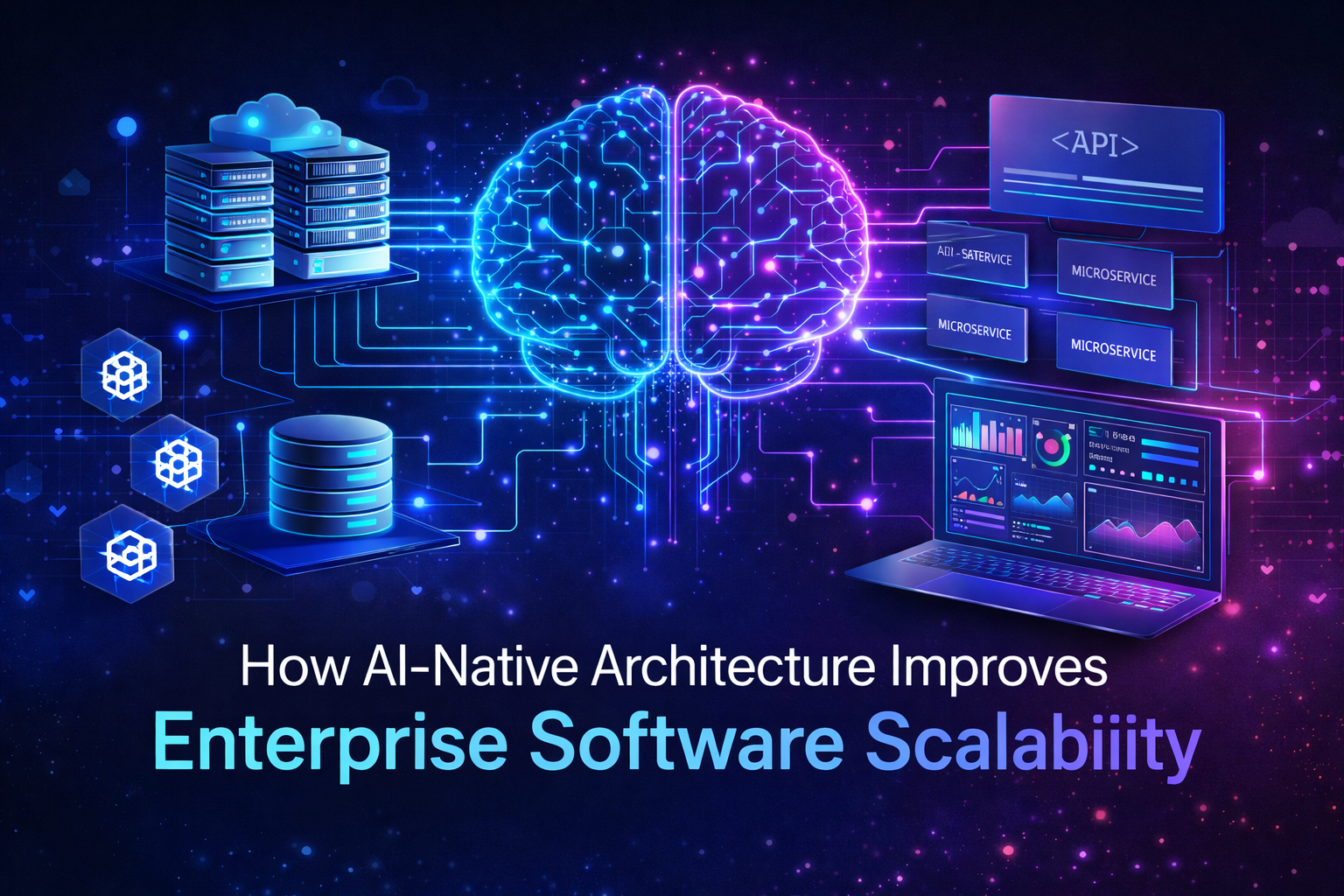
AI-native architecture enables enterprise software to scale efficiently using microservices, cloud infrastructure, and modern machine learning pipelines designed for high-volume data processing.
Traditional enterprise systems often struggle when data volumes grow. Most legacy platforms treat artificial intelligence as an add-on feature or an external layer. This reactive approach often leads to performance bottlenecks because the underlying infrastructure was never designed to support machine learning workloads.
AI-native architecture addresses this limitation by building the entire software stack around data processing and machine learning capabilities from the beginning. Instead of functioning as a secondary component, AI becomes the central engine powering the system. This architectural shift enables organizations to scale efficiently while maintaining performance and reliability.
The Core of Scalable AI Architecture
A scalable AI architecture focuses on how data flows through a system. Traditional enterprise designs often rely on a single server to handle both the user interface and the database. When machine learning models are added to the same server, it can easily lead to memory overload and system failures.
AI-native architecture separates these responsibilities to ensure stability and performance.
Resource Isolation
AI models are allocated their own dedicated memory and computing resources. This prevents intensive processes—such as complex search queries—from slowing down other functions like user authentication or page loading.
Elastic Scaling
The system dynamically provisions additional virtual servers as demand increases. Traffic levels are monitored continuously, allowing new instances to be deployed in seconds to maintain performance.
Cloud-Native AI Architecture
Technologies such as Kubernetes allow applications to run across multiple containers. Tasks are distributed across various servers, ensuring that no single machine becomes overloaded.
Infrastructure as Code
Developers define infrastructure through automated scripts. If a data center fails, the entire environment can be recreated instantly in another region, ensuring business continuity.
Microservices for AI Applications
Modern enterprise software increasingly relies on microservices to maintain flexibility and performance. Instead of building one large monolithic system, developers create multiple smaller services that perform specific tasks.
For example:
- One service collects data
- Another service processes and cleans the data
- A third service runs the machine learning model
This approach improves both development speed and system resilience.
Modular Development
Different teams can improve AI models independently without affecting other components such as billing or user management systems.
Fault Tolerance
If one service fails—for example, a data processing component—the rest of the system can continue operating without interruption.
API Communication
Each service communicates through high-speed APIs, allowing individual components to scale independently based on demand.
To maintain responsiveness, developers often use asynchronous frameworks such as FastAPI, which allow applications to process AI tasks in the background without freezing the user interface.
Building Scalable Machine Learning Systems
Scaling machine learning systems requires a modern approach to data storage. Traditional relational databases perform well for structured data such as names and dates but struggle when handling the high-dimensional vectors used in AI models.
AI-native systems solve this by incorporating vector databases optimized for machine learning workloads.
Automated Data Pipelines
These pipelines move data from source systems to machine learning models without manual intervention, ensuring that AI systems always operate on up-to-date information.
Model Versioning
Every model version is tracked and documented. If a newly deployed model performs poorly, developers can quickly revert to a previous stable version.
Asynchronous Processing
Requests are processed in the background, allowing users to continue interacting with the application while computational tasks are completed.
Feature Stores
Feature stores act as centralized repositories for pre-processed data used by multiple models. This reduces redundant computations and improves overall efficiency.
With these systems in place, applications handling 1,000 requests per minute can scale to millions of requests without significant performance degradation.
Managing Heavy Computational Loads
AI workloads often require specialized hardware such as GPUs. Traditional enterprise servers rely on CPUs, which are optimized for general computing tasks but perform poorly when executing AI algorithms.
Cloud-native AI architectures solve this challenge by allocating GPU resources only when they are needed.
On-Demand Provisioning
Organizations pay for GPU resources only when training or running machine learning models, significantly reducing operational costs.
Parallel Processing
Large computational tasks are divided into smaller segments and distributed across multiple servers, reducing processing time from hours to minutes.
Resource De-allocation
Once tasks are completed, the system automatically releases hardware resources, ensuring that infrastructure costs remain efficient.
This flexibility allows systems to scale seamlessly as user demand grows.
Data Consistency and Reliability
Maintaining data accuracy becomes increasingly challenging as enterprise systems grow. AI-native systems address this problem through event-driven architectures.
When new data enters the system, an event is broadcast across the network so that all relevant services can update their records immediately.
Pub/Sub Messaging
Services subscribe to specific topics and automatically receive updates when new data is published.
Real-Time Learning
AI models can incorporate new data instantly instead of waiting for scheduled updates.
Reduced Data Locking
Services do not depend on a single database operation, preventing system slowdowns during peak usage.
This architecture ensures that enterprise systems remain responsive even as the number of users and data streams increases.
The Strategic Importance of AI-Native Growth
In modern organizations, competitive advantage often depends on how quickly data can be converted into actionable insights.
Scalable AI-native systems enable companies to grow without sacrificing performance.
Consistent Performance
The system maintains stable response times regardless of whether it processes ten or ten thousand requests.
Reduced Technical Debt
Modular architecture allows engineers to upgrade individual components without rewriting the entire system.
High-Volume Data Processing
Scalable pipelines allow enterprises to process terabytes of data in real time, enabling deeper customer insights and faster decision-making.
Why Choose Bluelupin
BlueLupin Technologies builds enterprise platforms designed around modern AI-native principles.
Proven at National Scale
The company developed the INDIAai portal for the Government of India, managing millions of page views and large datasets of AI initiatives.
Modern Technology Stack
Teams leverage technologies such as React, Node.js, Python, AWS Lambda, and Kubernetes to deliver high-performance systems.
Enterprise Modernization Expertise
Bluelupin helps organizations migrate legacy enterprise software to cloud-native AI architectures, improving deployment speeds and system scalability.
Engineering-First Approach
The company’s founders are deeply involved in the design and development of projects, ensuring technical excellence and reliability.
Organizations looking to transition from legacy software to scalable AI systems can explore solutions and case studies at the Bluelupin website.
FAQs
What is the difference between AI-native and AI-enabled systems?
AI-enabled systems add machine learning capabilities to existing software. AI-native systems are designed from the ground up to support data pipelines, model training, and scalable AI infrastructure.
How do microservices reduce infrastructure costs?
Microservices allow organizations to run AI workloads separately from the main application, meaning expensive GPU resources are used only when required.
Does enterprise AI scalability require cloud infrastructure?
In most cases, yes. Cloud environments provide elastic resources that allow applications to scale instantly based on traffic and computational needs.
What are common challenges when scaling AI systems?
Typical risks include data bottlenecks, infrastructure limitations, and model drift. Proper monitoring, automated pipelines, and event-driven systems help mitigate these issues.
Can legacy enterprise systems transition to AI-native architecture?
Yes. Organizations often refactor legacy systems into microservices and gradually migrate components to cloud-native environments.
Final Thoughts
Scaling enterprise software is no longer just about adding more servers. It requires designing infrastructure that works seamlessly with intelligent algorithms and data-driven processes.
Organizations that continue to rely on monolithic legacy systems often face rising costs and performance limitations. By adopting AI-native architecture, businesses can process large volumes of data efficiently while maintaining a responsive user experience.
This approach creates a future-ready foundation where growth strengthens system capabilities instead of creating instability.
