
Advantages and disadvantages of chatbots for businesses
Advantages and disadvantages of chatbots for businesses in India: where chatbots save time, where they fail, and how handoff to your team limits the risk.

Updated 27 November 2026
Chatbots answer routine questions at any hour and handle many conversations at once, which cuts waiting time and support load. Their disadvantages are wrong or invented answers, trouble with complex or emotional cases, and ongoing review work, so the safest chatbots answer only from approved content and hand the conversation to a person when they are unsure.
We first wrote this post in January 2018. Since then, chatbots have started using language models, which helps with open questions and brings new risks. This update is for business owners, founders and product heads weighing a chatbot for support, sales or citizen service.
Checked 25 November 2026.
What counts as a chatbot in 2026
The word now covers four things:
- Rule-based chatbot. Follows fixed scripts and decision trees. Good for narrow, predictable questions.
- AI chatbot. Uses a language model to understand open-ended questions in everyday language. Good for broad help content.
- Conversational AI. Keeps context across a conversation, takes simple actions such as order or ticket lookups, and follows structured flows where needed. Good for customer support, sales and citizen service.
- AI agent. Completes multi-step work across your systems. See AI agent development for work that goes beyond answering questions.
Our conversational AI and chatbot development page explains these differences in more detail, and our post on how AI chatbots really work clears up common myths.
Advantages of chatbots
Answers at any hour
A customer who writes at 11 at night gets an answer straight away, and your team starts the morning with fewer open questions.
Many conversations at once
A sale, a scheme deadline or a service outage can bring a rush of the same question. A chatbot answers everyone at the same time, so no queue builds up.
Instant first reply from approved content
A well-built chatbot answers from the help articles, policies and FAQs you approve, so the reply comes in seconds.
Lower cost for routine questions
Questions about order status, opening hours or required documents come up often. When a chatbot handles them, your team can focus on complex and sensitive cases.
Hindi and English
One assistant can serve users in both languages. We test ours with real questions in Hindi and English before launch.
Actions and data
A chatbot connected to your CRM and helpdesk can look up orders and tickets, create leads, and pass the customer’s context to your agents. Its conversation analytics show where users get stuck.
Disadvantages of chatbots
Wrong or invented answers
A chatbot that uses a language model can give a confident answer that is wrong. OWASP lists this as LLM09:2025 Misinformation in its Top 10 for LLM applications.
On 14 February 2024 a British Columbia tribunal ordered Air Canada to pay a passenger CAD 812.02 in damages, interest and tribunal fees (Moffatt v. Air Canada, 2024 BCCRT 149). Its website chatbot had given him wrong information about bereavement fares, the BBC reported. The tribunal wrote: “It should be obvious to Air Canada that it is responsible for all the information on its website.”
The fix: let the chatbot answer only from content you approve, and have it say so when it is unsure.
Trouble with complex or emotional cases
Complaints, payment disputes and bereavement need a person. The fix: escalation rules that send these topics straight to your team.
Security and privacy risks
Prompt injection is when someone types instructions that trick the chatbot into ignoring its rules. Sensitive information disclosure is when it reveals data it should keep private, such as another customer’s details. OWASP ranks them LLM01 and LLM02 in its 2025 list. The fix: limit what data the chatbot can reach, and test it against these attacks before launch.
Abuse by users
In March 2016 Microsoft took its Tay chatbot offline and apologized. Its blog post said that in the first 24 hours online “a coordinated attack by a subset of people exploited a vulnerability in Tay”, which then posted “wildly inappropriate and reprehensible words and images”. The fix: expect people to try to misuse any public chatbot, and test for it.
Set-up and running costs
Cost depends on the number of channels, the integrations with your CRM and helpdesk, how much content the chatbot answers from, conversation volume and model usage. The fix: start with one channel and your most common questions.
Poor handoff frustrates users
If your agent has to ask the customer to repeat everything, the chatbot has slowed things down. The fix: pass the full conversation and customer details to your agent.
Ongoing review work
Someone has to read conversations, spot wrong or missing answers, and update the content after launch. Plan for this time from the start.
Advantages and disadvantages of chatbots at a glance
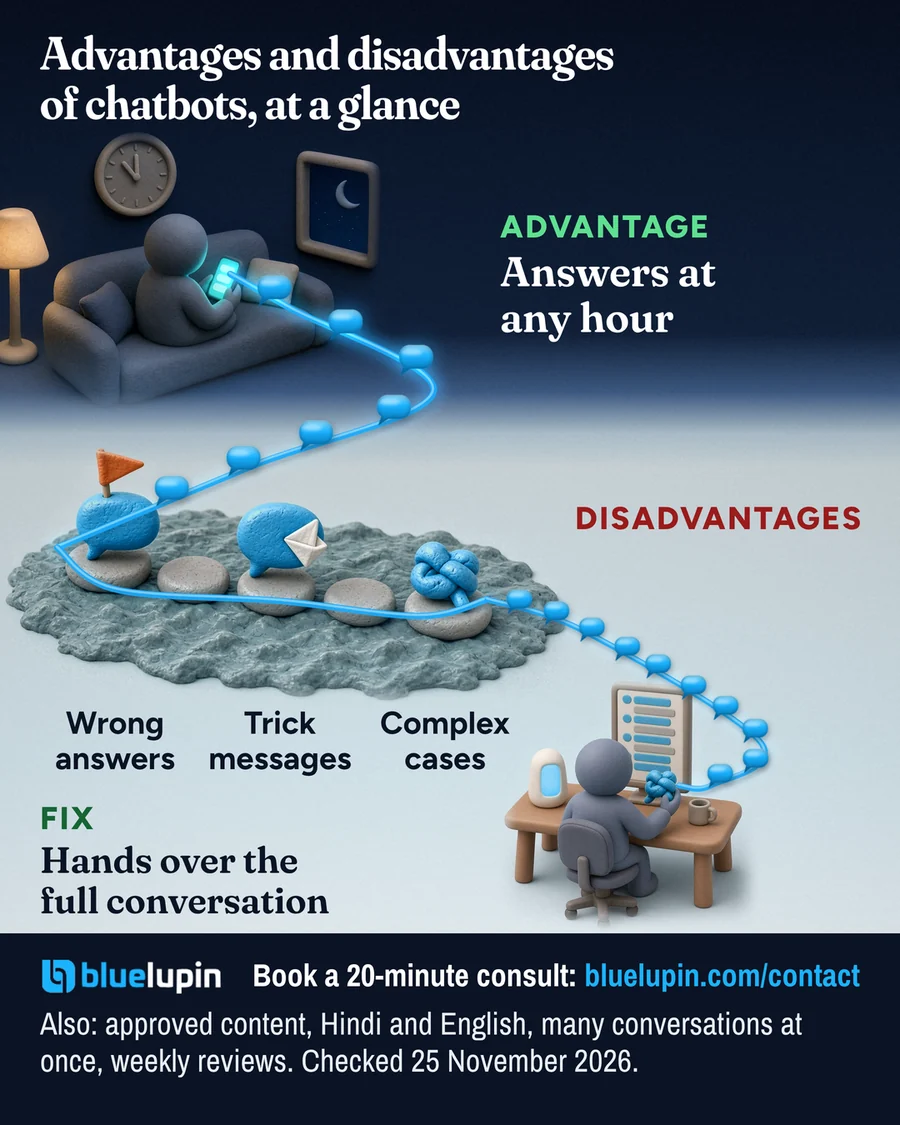
| Advantages | Disadvantages |
|---|---|
| Answers at any hour | Wrong or invented answers |
| Many conversations at once | Trouble with complex or emotional cases |
| Instant first reply from approved content | Prompt injection and data leaks |
| Lower cost for routine questions | Abuse by users |
| Hindi and English from one assistant | Set-up and running costs |
| Order and ticket lookups, leads in your CRM | Poor handoff, ongoing review work |
Checked 25 November 2026.
How to reduce the disadvantages
Every chatbot we build follows these practices:
- The assistant says it is a bot.
- Answers come only from content you approve.
- When it is unsure, it says so and offers a person.
- Handoff passes the full conversation history and customer details to your agent.
- Escalation rules cover complaints, payments and sensitive topics. For chatbots that take actions, see approval gates for AI agents.
- We test with real questions before launch, in both languages, and review conversations every week during the pilot.
Weighing the pros and cons of chatbots for your business
Start with who is asking, and what they need:
- Customers or citizens asking questions or getting help: conversational AI.
- Staff searching your own documents: RAG development.
- A system that completes multi-step work across tools: AI agent development.
- Fixed back-office steps after a request comes in: AI workflow automation.
Our list of questions to ask before adding a chatbot helps with the rest. On timing, a first prototype can be ready in 1 to 2 weeks, pilots usually take 4 to 8 weeks, and production systems usually take 3 to 6 months.
How Bluelupin builds chatbots
We build chatbots for web chat, mobile apps and Microsoft Teams, in Hindi and English, connected to CRMs and helpdesks such as Salesforce, HubSpot and Zoho. Our conversational AI and chatbot development page covers how.
We also designed and built Lunaras, a company-aware AI platform now in beta, where the assistant that answers a question can also run the next step. Our AI agent development page has the details.
FAQs
What are the advantages and disadvantages of chatbots?
Chatbots answer routine questions at any hour, handle many conversations at once and lower the load on your team. Their disadvantages are wrong answers, trouble with complex or emotional cases, security risks such as prompt injection, and ongoing review work.
What are the disadvantages of chatbots?
The main ones are wrong or invented answers, weak handling of complaints and sensitive cases, exposure to prompt injection and data leaks, set-up and running costs, and frustration when handoff to a person is poor.
What are the advantages and disadvantages of chatbot use on a website?
On a website, a chatbot gives an instant first reply and can collect leads or look up orders. It needs approved content, a clear “this is a bot” message and a quick route to a person.
What is the difference between a chatbot and conversational AI?
A basic chatbot follows fixed scripts and decision trees. Conversational AI uses language models to understand open-ended questions, keep context across a conversation and take simple actions.
How do you stop a chatbot giving wrong answers?
Let it answer only from content you approve, have it say when it is unsure and offer a person, test it with real questions before launch, and review conversations after launch.
Can a chatbot work in Hindi and English?
Yes. Bluelupin builds chatbots that understand and answer in Hindi and English, and tests them with real questions in both languages before launch.
What drives the cost of a chatbot?
The number of channels, integrations with your CRM and helpdesk, how much content it answers from, conversation volume and model usage.
Planning a chatbot for support, sales or citizen service? Tell us what your users ask most and where they reach you, and we will help you plan the first step.