

Introduction
Decision-making within contemporary organizations is becoming more challenging. Information is generated from numerous sources such as customer interactions, market trends, and internal systems. Teams feel compelled to respond quickly and accurately. Managing this enormous quantity of information without drowning individuals is a significant issue.
To meet this need, businesses are utilizing smart systems that can interpret information independently, make decisions, and take action. Such systems are called autonomous AI agents. They are not just automation tools. They are programmed to execute missions with a minimal amount of supervision and respond to changing information and environments.
What are autonomous AI agents?
Autonomous AI agents are intelligent software that can consider a situation, make sound judgments, and act without assistance from people. They are advanced compared to standard automation since they utilize real-time data, comprehend the context, and learn how to function.
Rather than rigidly following rules, such agents observe evolving situations and adapt what they do. For instance, in customer service, a trained AI agent can sense the emotional state of the user, refer to previous conversations, and select the optimal next action. It can fix the issue itself or transfer it to a human agent if required, depending on the case.
Basic Elements That Support Independent AI Agents
Behind every autonomous agent is a set of smart technologies working together. They are not one-time-use agents. They exist because of a set of systems that handle information, process logic, and provide useful information based on context.
At its core are sophisticated AI models, including those developed on OpenAI GPT-based architectures. These models interpret human language, recognize patterns, and return contextual answers that simulate reason. This enables the agent to grasp input and choose a beneficial response.
To stay current, autonomous agents have access to real-time data. This data could be collected from web scraping, APIs, local databases, or physical sensors. Whether tracking customer feedback or tracking traffic updates to manage logistics, the agent is using this data to stay cognizant of the present state of things.
Integration is extremely crucial. Agents tend to link to systems such as AI search engines, customer relationship management (CRM) software, or workflow automation systems. This integration ensures they understand what is occurring and act within a larger system to have an impact.
How Autonomous Agents Learn and Adapt

Learning is what sets a static automation script apart from a genuine autonomous agent. Such machines don’t merely respond—they adapt based on new data and results.
The majority of agents start with supervised learning. They learn from labeled data with known correct actions. As they observe more examples, the model learns to handle similar but new inputs.
Reinforcement learning is applied in varying situations. The agent learns by trial and error and experimenting. It receives feedback in the form of reward or punishment for what it does and adjusts its approach accordingly. This type of learning comes in handy when there are no rigid rules.
Business Use Cases: How Autonomous Agents Drive Results
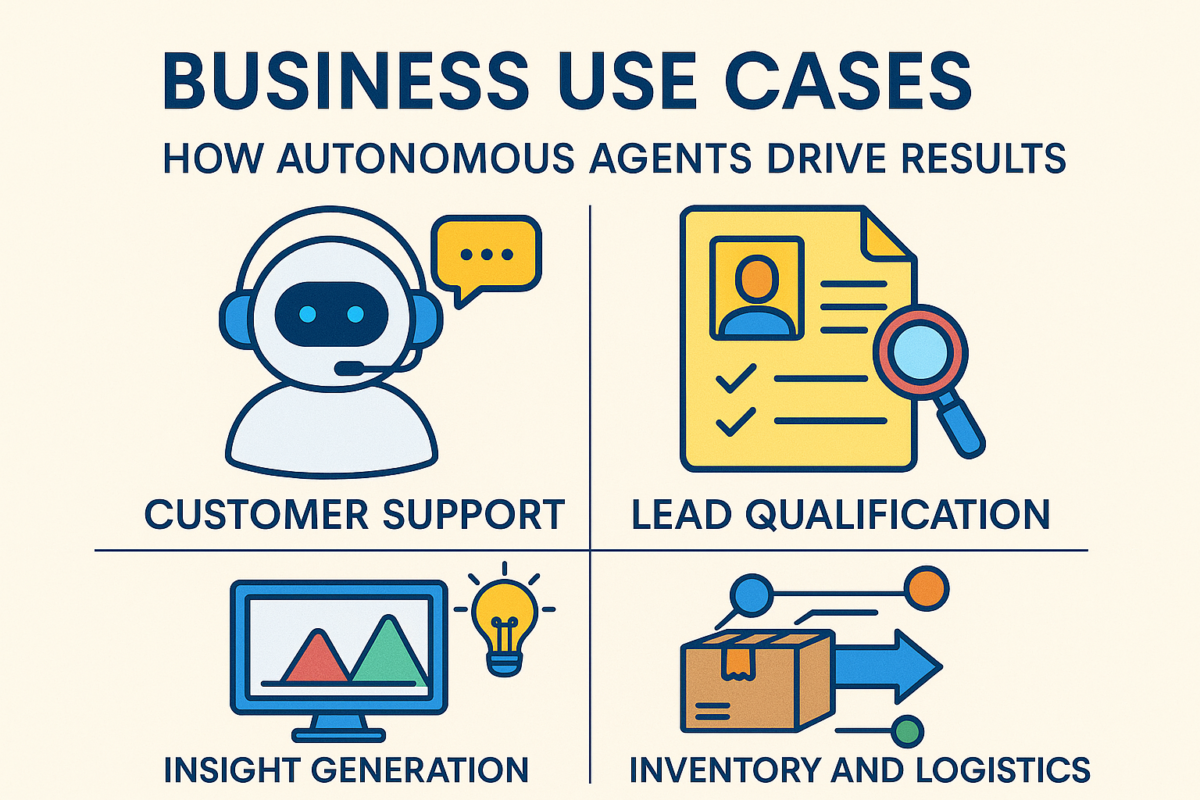
Autonomous AI agents are not confined to the lab or tech demonstrations. Companies in all but a few industries are already seeing practical applications that make things more efficient and faster and provide improved quality service.
Customer Support:
By integrating an OpenAI chatbot, businesses can utilize agents that handle large volumes of support requests. The bots can detect intent, access previous interactions, and solve issues without engaging human staff unless absolutely necessary.
Lead Qualification:
Agents can collect data from the internet using web scraping. They can get information from places like LinkedIn, company websites, or financial reports. After that, they check and qualify leads before sending them to a sales system or CRM.
Insight Generation:
Agents can research, contrast trends, or find answers to tough questions quickly with the help of AI search engines like You.com or Andi. This allows teams to make more and quicker decisions.
Inventory and Logistics:
Supply chain agents monitor the amount of inventory in stock, predict when demand will increase, and alter shipping routes when required. Agents make these decisions based on both internal information and external information like weather reports or traffic patterns.
Value to Today’s Teams
Autonomous AI agents offer practical benefits that fix real-world issues. They reduce manual labor, enable improved decision-making, and facilitate faster responses.
One of the greatest advantages is the time saved. Agents can do routine tasks such as data entry, ticket classification, and status tracking. This reduces the workload on human teams and allows them to focus on more critical tasks.
They also enable real-time responsiveness. Rather than sitting around for batched updates or manual approvals, agents see live inputs and respond in real time. For instance, they can reroute deliveries based on traffic feeds or respond to high-priority support tickets as they arrive.
Scalability is another advantage. Once installed, standalone agents can perform the same task on numerous systems or in numerous areas without requiring extra resources. This ensures consistency and velocity as a business grows.
Beginning with Autonomous Agents
Employing autonomous agents does not require a total system overhaul. Organizations can begin with certain applications and expand depending on what they discover.
The initial step is typically engaging AI development services. These groups assist in determining where automation is necessary and which processes are most appropriate to be performed by machines independently.
Second is selecting the appropriate tools. Tools such as n8n and Zapier enable teams to connect agents with APIs, spreadsheets, messaging platforms, and databases with minimal coding. For more sophisticated requirements, tools such as LangChain provide the ability to develop agents capable of language understanding and reasoning.
One of the best ways to begin is small. Pilot an agent in a contained environment, such as internal question handling or a regular reporting process. A contained environment offers teams the power to refine the logic and validate the result prior to applying the same process at a larger level.
Pilot deployments assist in determining how agents fit into existing systems, what they must know, and how to effectively measure their performance.
Conclusion
Autonomous AI agents are revolutionizing how organizations decide and process data. They lower the amount of work people have to do, support instant response, and can scale easily within domains. Companies can take advantage while still being in control by beginning small and focusing on security. Autonomous AI agents are not just a tool; they are a significant asset for today’s teams that want to innovate and remain competitive.
FAQ
Q1: How do self-directed AI agents differ from chatbots?
Autonomous agents are much more complex than simple interactions because they process information, decide, and execute tasks on their own, while chatbots are generally constrained to pre-scripted answers or responding to simple questions.
Q2: Can these agents use our existing tools?
Yes, the majority of agents interact with tools such as CRMs, analytics dashboards, or workflow automation tools via APIs or connectors.
Q3: How do we make agents make good decisions?
Agents apply logic-based decision-making paradigms and learning models, fine-tuned during development and periodically checked to ensure compliance.