


Updated October 2026
Keep software development in-house when the software is your core product and you can hire and lead engineers for years. Outsource when you need skills or capacity faster than hiring allows, or the work has a clear end. Many businesses use a hybrid: their own product owner sets direction while a partner team builds.
The old version of this post framed outsourcing vs in-house development as two options and quoted US salaries. The real choice has more than two answers, so we rewrote it. If you haven’t yet decided whether to build at all, start with custom vs off-the-shelf software.
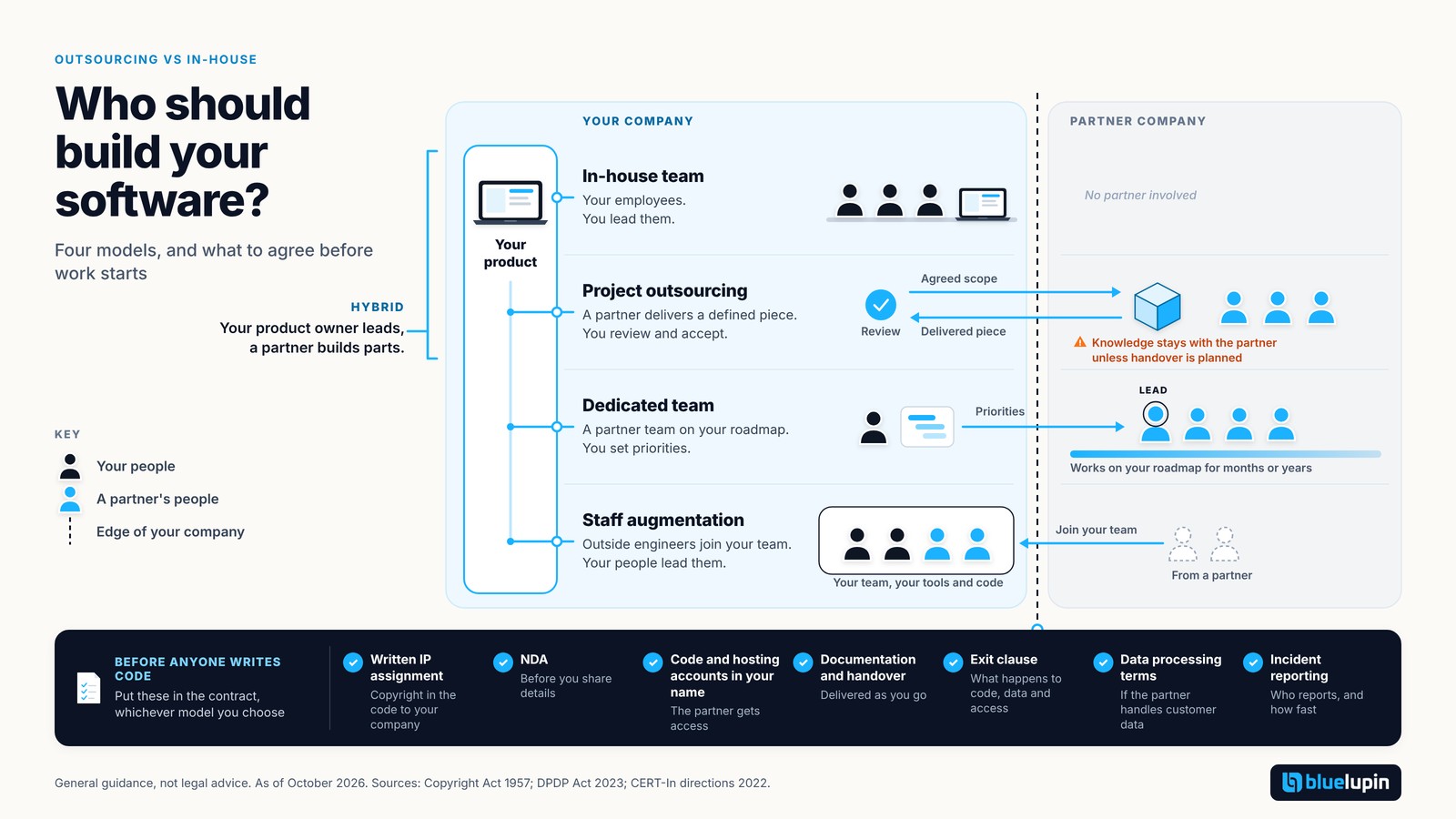
The four ways to get software built
There are four common models, and you can combine them.
In-house team
Engineers on your payroll who work only on your product. You hire them, set their priorities and manage them. Knowledge stays while they stay.
Project outsourcing
A partner delivers a defined piece of work, such as an app or a module, against an agreed scope. They manage their people; you brief, review and accept.
Dedicated team
A partner team works on your roadmap for months or years, often with its own lead, and you set the priorities. In the dedicated development team vs in-house team choice, it’s the closest thing to your own team without hiring one.
Staff augmentation
Individual outside engineers join your existing team to fill a skill or capacity gap, working in your tools and code. That’s the main difference in staff augmentation vs outsourcing: your people lead the work.
A hybrid mixes these. A typical version is in-house product ownership with a partner building parts of the product.
Outsourcing vs in-house software development compared
| In-house team | Project outsourcing | Dedicated team | Staff augmentation | |
|---|---|---|---|---|
| Who directs daily work | You | The partner, against an agreed scope | Shared; you set priorities | You |
| Time to start | Slowest; you recruit first | Fast once scope is agreed | Fast once the team is formed | Fast for individual roles |
| Cost shape | Mostly fixed: salaries, benefits, tools, management | Per project; changes cost extra | Monthly per team | Monthly or hourly per person |
| Scaling up or down | Slow; hiring and notice periods | Per project | Within contract terms | Within contract terms |
| Knowledge retention | Stays while people stay | Stays with the partner unless handover is planned | Better if they work in your repository | Good if they work in your repository |
| Your management time | High | Lower during build; you still review and accept | Medium | High; you lead them |
| Best for | Software that is your core product, with steady long-term work | A defined piece of work with a clear end | A long roadmap without building a full team yet | A team that exists but lacks skills or capacity |
No column wins every row.
Questions to answer before you choose
- Is the software your product, or does it support a business that sells something else? If customers pay for the software itself, you’ll want core skills inside over time.
- Is there enough work to keep engineers busy every week, for years? If not, salaried engineers sit idle between projects.
- Do you have someone senior who can set direction and review work? Every model needs this person.
- How clear is the scope? A clear scope suits project outsourcing. A scope that keeps changing suits a team you direct.
- How soon do you need it? Recruiting a full team takes time; a partner can usually start sooner.
- Who will run and change it after launch? Decide now, because it shapes the contract and handover.
Cost: what you actually pay for in each model
In-house vs outsourcing software development costs are easy to compare badly, because salary is only part of what you pay.
In-house, count recruiting time, salaries and benefits, notice periods while you wait for people to join, management time, tools, and the cost of replacing people who leave.
Outsourced, count the vendor’s fees plus your own time to brief, review and accept the work.
Which side costs less depends on how long the work lasts and how much of your own time it needs. A project with a clear end avoids the fixed costs of hiring, while steady, long-term work can favor your own team.
Fixed price, milestones or time and materials
How you pay is a separate choice from who builds. Fixed price suits a clear, stable scope, and changes are priced separately. Time and materials means you pay for the hours worked, which suits changing priorities. Milestone payments sit between the two: you pay as agreed pieces are delivered and accepted.
When a hybrid team works best
A hybrid development team works when your own people keep product direction, architecture decisions and final review, and a partner builds defined parts. The habits that make it work:
- One named internal owner who makes product calls
- A shared code repository (the place where the code is stored and versioned) that your company controls
- Regular demos of working software
- Clear boundaries between the parts each side builds
AI coding tools can help a small team, in-house or outsourced, cover more routine work, as long as an engineer still reviews every change. We wrote about how AI coding tools fit into a reviewed process and how testing changed with AI tools.
What to put in the contract before anyone writes code
Whatever model you choose, sort these out before work starts:
- A written assignment of copyright in the code to your company. Under India’s Copyright Act, an outside author is the first owner of the work unless an agreement says otherwise, and an assignment is valid only in writing.
- An NDA (non-disclosure agreement) before you share details of your idea or business.
- Code repository, hosting and domain accounts in your company’s name, with the partner given access.
- Documentation and a handover plan, delivered as you go.
- An exit and transition clause: what happens to the code, data and access if either side ends the contract.
- Data processing terms if the partner will handle your customers’ personal data. Under the DPDP Act, you stay responsible for processing done on your behalf, and a processor can be engaged only under a valid contract. These duties apply from 13 May 2027. More on DPDP duties that start in May 2027.
- Who reports a security incident, and how fast. CERT-In’s 2022 directions require the organizations they cover to report listed cyber incidents within 6 hours of noticing them.
This checklist is general information, not legal advice. Have your lawyer review the contract before you sign. For choosing the partner itself, see how to choose a development partner.
Moving development in-house later
Starting with a partner and hiring later can work well if you plan it from day one: keep the accounts in your name, get documentation as you go, and agree on an overlap period with knowledge transfer sessions for your new hires.
Outsourcing vs in-house software development: FAQs
Is outsourcing cheaper than hiring an in-house team?
Not always. Compare the full cost of hiring (recruiting, salaries, benefits, notice periods, management, tools, replacing people who leave) with vendor fees plus your own time to brief and review. For work with a clear end, a partner avoids the fixed costs of hiring; for steady long-term work, your own team can come out ahead. Run the numbers for your own case.
What is the difference between a dedicated team and staff augmentation?
A dedicated team is a partner team working on your roadmap over months, often with its own lead. Staff augmentation adds individual outside engineers to your team, and your people lead them.
Who owns the code when an outside company builds it?
Under India’s Copyright Act, the author is the first owner unless the work is made by an employee under a contract of service or an agreement says otherwise. An assignment is valid only in writing. So put a written IP assignment in the contract. Not legal advice; ask your lawyer.
If a partner handles my customers’ data, who is responsible under DPDP?
You are, if you decide why and how the data is used. The Act holds the Data Fiduciary responsible for processing done on its behalf, and a processor can be engaged only under a valid contract. These duties apply from 13 May 2027. Not legal advice.
Can I start with an outsourced team and bring development in-house later?
Yes, if you plan for it from the start: keep the code repository and hosting accounts in your name, ask for documentation as you go, and agree on a handover period with knowledge transfer before the partner steps back.
If you’re still deciding
To see an example, here is how one custom software partner structures this work. For something small and well defined, Bluelupin also offers small fixed-price builds: a website from $999 or an app for one business process from $2,999.
Sources
- Copyright Act 1957, sections 17 and 19: https://www.copyright.gov.in/Documents/Copyright_Act_1957.pdf
- Digital Personal Data Protection Act 2023, section 8: https://www.meity.gov.in/static/uploads/2024/06/2bf1f0e9f04e6fb4f8fef35e82c42aa5.pdf
- Digital Personal Data Protection Rules 2025: https://www.meity.gov.in/static/uploads/2025/11/53450e6e5dc0bfa85ebd78686cadad39.pdf
- CERT-In directions under section 70B(6), 28 April 2022: https://www.cert-in.org.in/PDF/CERT-In_Directions_70B_28.04.2022.pdf
- GOV.UK Service Manual, Choosing technology: https://www.gov.uk/service-manual/technology/choosing-technology-an-introduction
- Bluelupin Blitz: https://bluelupin.com/blitz