


Say you want competitor prices or property listings pulled from a few websites into a spreadsheet every morning. Your team says “we can do that in Python”, and they’re right. The first question is which tool to use. The second is whether you’re allowed to collect that data. This post answers both.
Updated 31 October 2026. Versions change often, so check each project page.
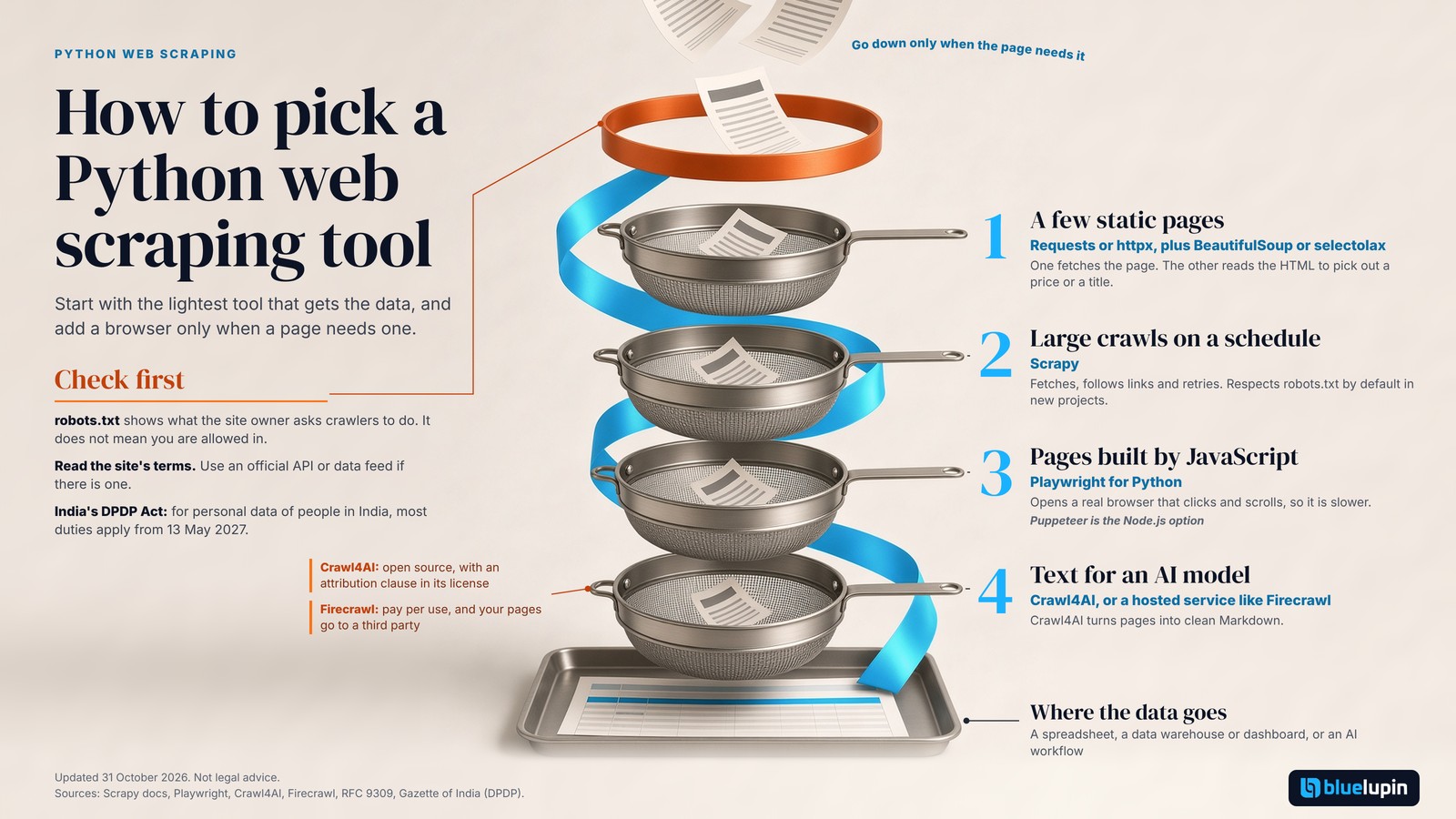
There is no single best web scraping tool for Python. For a few static pages, use Requests or httpx with BeautifulSoup. For large crawls that run on a schedule, use Scrapy. For pages built by JavaScript, use Playwright for Python. For text that feeds an AI model, try Crawl4AI or a hosted service like Firecrawl. Puppeteer is the Node.js option.
The short answer: a decision table
| Tool | What it is | Runs JavaScript? | Good for | Watch out for |
|---|---|---|---|---|
| Requests or httpx, plus BeautifulSoup or selectolax | A fetcher plus an HTML parser | No | A few static pages | You build retries and scheduling yourself |
| Scrapy | A full crawling framework | With the scrapy-playwright add-on | Large crawls on a schedule | More to learn than a short script |
| Playwright for Python | Drives real Chromium, Firefox or WebKit browsers | Yes | JavaScript-heavy sites, logins, clicks | Slower and heavier than plain HTTP |
| Crawl4AI | Open source crawler that outputs Markdown for AI | Yes (browser based) | Feeding an AI model or knowledge base | Fast releases, and an attribution clause in its license |
| Firecrawl, or LLM extraction | Hosted API with a Python SDK. LLM extraction asks a model to pull fields from a page | Yes (hosted) | Teams that don’t want to run browsers | Pay per use, and your pages go to a third party |
| Puppeteer (Node.js) | A JavaScript library for Chrome and Firefox | Yes | Teams already working in Node.js | Python teams usually pick Playwright instead |
Start with the lightest option that gets the data, and add a browser only when a page needs one, because browsers cost more and break more often. We left out speed charts, since the ones we found come from vendors testing their own products. New to scraping? Start with Web scraping 101: how machines read the web.
Python web scraping libraries, one by one
Requests or httpx with BeautifulSoup or selectolax
Fetching and reading are separate jobs. Requests fetches the page. BeautifulSoup reads the HTML so you can pick out a price or a title. Its speed depends on the parser underneath, usually lxml. selectolax is a faster parser built on the Lexbor engine. httpx’s last release was 0.28.1 (December 2024), and Pydantic now maintains it as httpx2.
Scrapy
Scrapy is built for large crawls that repeat. It fetches, follows links and retries, with polite defaults. Its docs say the robots.txt setting “is enabled by default in settings.py file generated by scrapy startproject” (settings), and since 2.13.3 the project template waits 1 second between requests and sends 1 request at a time per site (release notes). Version 2.19 adds a RemoteControl extension, enabled by default, that connects to a running crawl. Check it before you deploy.
Playwright for Python
Playwright for Python is the usual pick for sites that build their content with JavaScript. It opens a real browser that can click, scroll and log in, so it’s slower. Inside Scrapy, scrapy-playwright opens a browser for just those pages. Our cross-browser automation guide covers the testing side.
Crawl4AI
Crawl4AI describes itself as an “Open-source LLM Friendly Web Crawler & scraper”. It turns pages into clean Markdown, a format AI models and RAG knowledge bases handle well. Its license is Apache 2.0 plus a clause requiring visible credit when you use it.
Firecrawl and LLM extraction
Firecrawl is a hosted service. Its SDK calls it “the context API for AI agents” (PyPI). You send a URL and get back AI-ready content. The SDK is MIT licensed and the server code is AGPL 3.0: if you change that server and offer it to others over a network, you must share your changes. LLM extraction, where a model reads a messy page and returns the fields you want, helps when layouts vary. It costs per page, and results need checking.
Where Puppeteer fits
Puppeteer is a Node.js library. It has supported Firefox, along with Chrome, since version 23 in August 2024. For a Python team, Playwright covers the same work.
Before you scrape: robots.txt, terms, rate limits and India’s DPDP Act
This is our plain reading of the public texts. It isn’t legal advice, so check any project that collects personal data with a lawyer.
robots.txt. The robots.txt standard, RFC 9309, describes its rules as ones “that crawlers are requested to honor”, and also says: “These rules are not a form of access authorization.” Following it is good practice, but it doesn’t settle whether you’re legally allowed in.
Terms of use. Read the site’s terms first. Many forbid automated access. Whether they bind you depends on the country and how you accepted them. If the site offers an official API or data feed, use that. It’s more stable, and the owner has approved it.
Rate limits. Go slowly, name your crawler, and stop if the site pushes back. Scrapy’s project template default of one request per second per site is a sensible start. The law sets no such number.
India’s DPDP Act. On 13 November 2025 the government notified the start dates for the Digital Personal Data Protection Act, 2023 and the DPDP Rules 2025 (PIB summary). Most of the Act starts on 13 May 2027. That includes Section 3 (where the Act applies), the business duties such as notice, consent and breach reporting, and the penalties.
Scraping names, phone numbers or emails of people in India is processing personal data, so plan for those duties now. Section 3(c)(ii) of the Act says it shall not apply to:
personal data that is made or caused to be made publicly available by
(A) the Data Principal to whom such personal data relates; or
(B) any other person who is under an obligation under any law for the time being in force in India to make such personal data publicly available.
That names two sources: the person themselves, or someone legally required to publish the data. It doesn’t mention data a third party posted about someone, such as a directory listing a phone number. When in doubt, treat personal data as covered. Our DPDP roadmap and PII tokenization posts go deeper.
India’s IT Act. Section 43 of the IT Act, 2000 makes a person who “downloads, copies or extracts any data” from a computer system “without permission of the owner” liable to pay compensation. How this applies to public websites isn’t settled in one clear rule, which is another reason to respect a site’s terms.
Build it yourself or hand it over?
A one-off scrape is an afternoon’s job for someone on your team. A scraper your business depends on every day is a small product. Ask:
- How many sites, and how often?
- How often do those sites change layout? Each change can break the scraper.
- Where does the data go: a spreadsheet, a data warehouse or dashboard, or an AI workflow?
- Does it include personal data of people in India?
- Who fixes it when it breaks?
If the answers point to many sites and important data, plan it like any software you rely on, with monitoring and an owner. Our post on custom vs off-the-shelf software walks through that call.
Wrapping up
Pick the lightest tool that gets the data, then check robots.txt, the site’s terms and the DPDP Act before you collect anything about people.
Bluelupin builds scrapers and data pipelines for businesses. We can help you pick the tool, plan for the legal basics, and deliver clean data into your systems or AI tools, with monitoring for when a site changes. If you’d like to talk it through, book a consultation or write to sales@bluelupin.com.
FAQ
What is the best web scraping tool for Python?
It depends on the site. BeautifulSoup with Requests for static pages, Scrapy for repeat crawls, Playwright for JavaScript sites, Crawl4AI or Firecrawl for AI-ready text.
Is Scrapy better than BeautifulSoup?
They do different jobs. BeautifulSoup reads HTML you already fetched. Scrapy fetches, follows links and retries, so it suits bigger crawls.
Can Python scrape websites that use JavaScript?
Yes. Playwright for Python runs a real browser, and scrapy-playwright adds one to Scrapy.
Should I use Puppeteer or Playwright?
Puppeteer is a Node.js library. A Python team should use Playwright for Python.
Is web scraping legal in India?
There is no single yes or no. Respect robots.txt and site terms. Personal data falls under the DPDP Act, with duties from 13 May 2027, and its public data exemption is narrow.
Does robots.txt make scraping legal?
No. RFC 9309 says its rules “are not a form of access authorization”. It shows what the site owner asks crawlers to do.