
WhatsApp SIM binding: what changes for business teams
WhatsApp SIM binding takes hold by 31 December 2026. What it means for teams that sell and support customers on WhatsApp, and what to change now.


A made-up example. A shop’s WhatsApp Business number lives on an old phone in a drawer, while three staff answer customers on WhatsApp Web at the counter. That setup is what India’s WhatsApp SIM binding rule is aimed at.
Based on DoT’s directions and the government’s April 2026 reply in Parliament, checked 16 November 2026. Each app decides how it implements the rule, so details may change. This is a plain-language summary and isn’t legal advice.
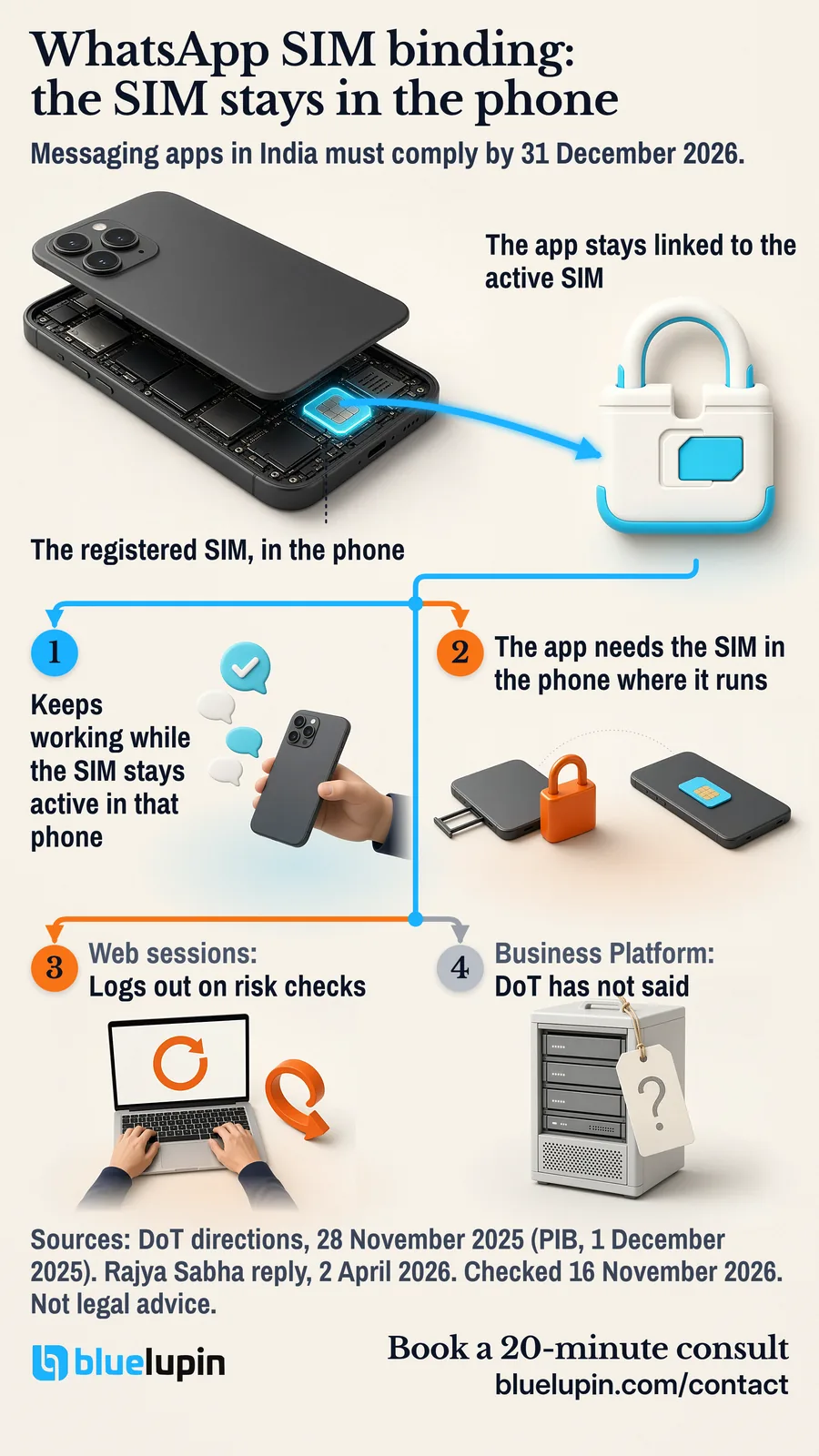
WhatsApp SIM binding is a Department of Telecommunications rule that requires WhatsApp and seven other messaging apps to stay linked to the active SIM of the registered number, in the same phone. Platforms must comply by 31 December 2026. Web sessions will log out based on each app’s risk checks instead of a fixed timer.
What is WhatsApp SIM binding?
On 28 November 2025, the Department of Telecommunications issued Directions under the Telecom Cyber Security Rules, 2024 (as amended). The directions went to eight apps: WhatsApp, Telegram, Snapchat, Arattai, ShareChat, Josh, JioChat and Signal. Each app must stay continuously linked to the SIM of the registered number, installed in the device, “making it impossible to use the app without that specific, active SIM” (PIB release, 1 December 2025).
DoT’s stated reason is that accounts can be kept running after the SIM is removed or taken abroad, and then used for fraud. If you travel with that SIM still in the phone, roaming is unaffected.
The registered SIM must be in the phone running the app. Wi-Fi does not replace it. How each app enforces this is up to the app. As of 16 November 2026, WhatsApp and Meta had not published a help page that describes the exact India behavior, so we will not guess at linked devices, tablets or dual SIM setups.
When does it start?
The original order gave platforms 90 days to implement the rule and 120 days to report. In a written reply to the Rajya Sabha on 2 April 2026, the government said the compliance timeframe is 31 December 2026 (Rajya Sabha Unstarred Question 4331).
News reports, for example India Today on 23 October 2026, describe the rule as applying from 1 January 2027, the day after that deadline. That is a fair way to read it: platforms must comply by 31 December 2026, so the rule applies from 1 January 2027 at the latest. Some earlier coverage treated the original 90-day window as a March 2026 start date. The April 2026 parliamentary answer superseded that, so teams should plan to the December deadline.
Does WhatsApp Web still log out every six hours?
This is a point that still gets repeated incorrectly. DoT’s December 2025 release said web sessions should log out “not later than 6 hours”, with QR re-linking. The April 2026 Rajya Sabha answer changed that. Web instances “are required to be logged out on the basis of risk-based analysis. No specific time period has been stipulated for such logging out.”
Some later articles still say six hours. The current official position is that web sessions will log out based on each app’s risk checks. DoT no longer sets a fixed interval. You should expect to re-link by QR code, on each app’s own schedule. For a team that shares WhatsApp Web at a counter, that means someone with the phone and SIM should be available to re-link when the app asks.
What changes for a business on the WhatsApp Business app?
| How your team uses WhatsApp today | What the rule points to |
|---|---|
| Business number on a phone, SIM inside | Keeps working while the SIM stays active in that phone |
| Business number’s SIM moved to another phone, app on the first | The app needs the SIM in the phone where it runs |
| Several staff on WhatsApp Web or desktop | Sessions can be logged out by the app’s risk checks; plan for re-linking |
| Number on the WhatsApp Business Platform (Cloud API) through a CRM or helpdesk | DoT has not said; the platform runs on Meta’s servers |
Two practical issues follow.
First, who in the team holds the phone with the SIM, and what happens when that person is on leave? If the business number lives on one handset, that handset and its SIM have to stay available for the app to run. In a shop or a support desk, that often means nominating a deputy, and making sure the handset is not left at home or in a drawer when the usual person is away.
Second, in our view, a sudden logout on WhatsApp Web can cut staff off from chat history and customer context mid-conversation. That is why customer records should not live only inside the chat app.
What about the WhatsApp Business Platform?
The directions describe an app on a phone with a SIM. The WhatsApp Business Platform’s Cloud API processes messages on servers in Meta data centers (Meta, Cloud API data privacy). A number registered on the Cloud API cannot also be used with the WhatsApp app. Eligible numbers must be able to receive voice calls or SMS, and fixed-line numbers are listed (Meta, business phone numbers).
DoT has not said whether or how the rules apply to the Business Platform. We will not guess. In our view, teams that already answer many customers have reasons to connect your CRM and helpdesk, and this rule adds one more reason to compare that option with staying on the app. That is not a promise that the Business Platform avoids the rule.
What we’d do before 31 December 2026
These are our recommendations. There is still time to change how the team works before the deadline.
- List every business number, which phone holds its SIM, and who has that phone.
- Count who answers customers on WhatsApp Web or desktop, and how a forced logout would hit them.
- Keep customer records outside chat apps, in your CRM or helpdesk, including the personal data in customer chats that you will still need if a session drops.
- If volume is high, compare the WhatsApp Business Platform through your CRM or helpdesk with staying on the app. That comparison can include customer support and sales assistants connected to your CRM.
- Watch each app’s own announcements. Details of how WhatsApp, and the other named apps, will behave will come from the platforms themselves.
A lesson for apps that sign users in with a phone number
An OTP sent once at sign-up proves the number at that moment only. Payment apps already bind to the device and SIM under RBI rules (paragraph 31(c) of the 5 November 2026 Master Directions). See RBI’s device and SIM binding rule for payment apps. If your app holds money or sensitive data, ask whether a one-time OTP is still enough. This is also a secure sign-in question for product teams. This is our view. The messaging-app directions do not themselves place a new duty on apps that are not on DoT’s list.
Common questions
When does SIM binding start in India?
DoT told Parliament the compliance timeframe is 31 December 2026, so platforms must comply by then. News reports say it applies from 1 January 2027.
Will WhatsApp Web log out every six hours?
DoT’s December 2025 order said six hours, but the government said in April 2026 that web sessions log out based on risk analysis, with no fixed interval.
Will WhatsApp work on Wi-Fi without the SIM?
The rule requires the registered SIM to be active and in the phone running the app. Wi-Fi does not replace it. Using the app while roaming with the SIM in the phone is unaffected.
Does SIM binding apply to the WhatsApp Business API?
DoT has not said. The directions describe an app on a phone with a SIM; the WhatsApp Business Platform’s Cloud API runs on Meta’s servers. Watch for guidance from DoT and Meta.
If your customer conversations live on a few phones and WhatsApp Web, we can help you move them into the CRM or helpdesk your team already uses, with handoff to people when needed. Book a 20-minute consult.