
Indian open AI models: can you use them?
Which Indian open-source AI models can you download, use commercially and run on your own servers? Sarvam, BharatGen, EKA-1, Dhīr and Gnani checked.

A typical question from a product team in India: is there an Indian model we can run on our own servers, that handles Hindi and Tamil, and that we may use inside a paid product? In November 2026 the answer is yes, for a few of them. The details decide which ones.
Licences and download pages checked 23 November 2026 from the model cards and the makers’ own pages. Model terms change, so read each licence before you build. This is a plain-language summary and isn’t legal advice.
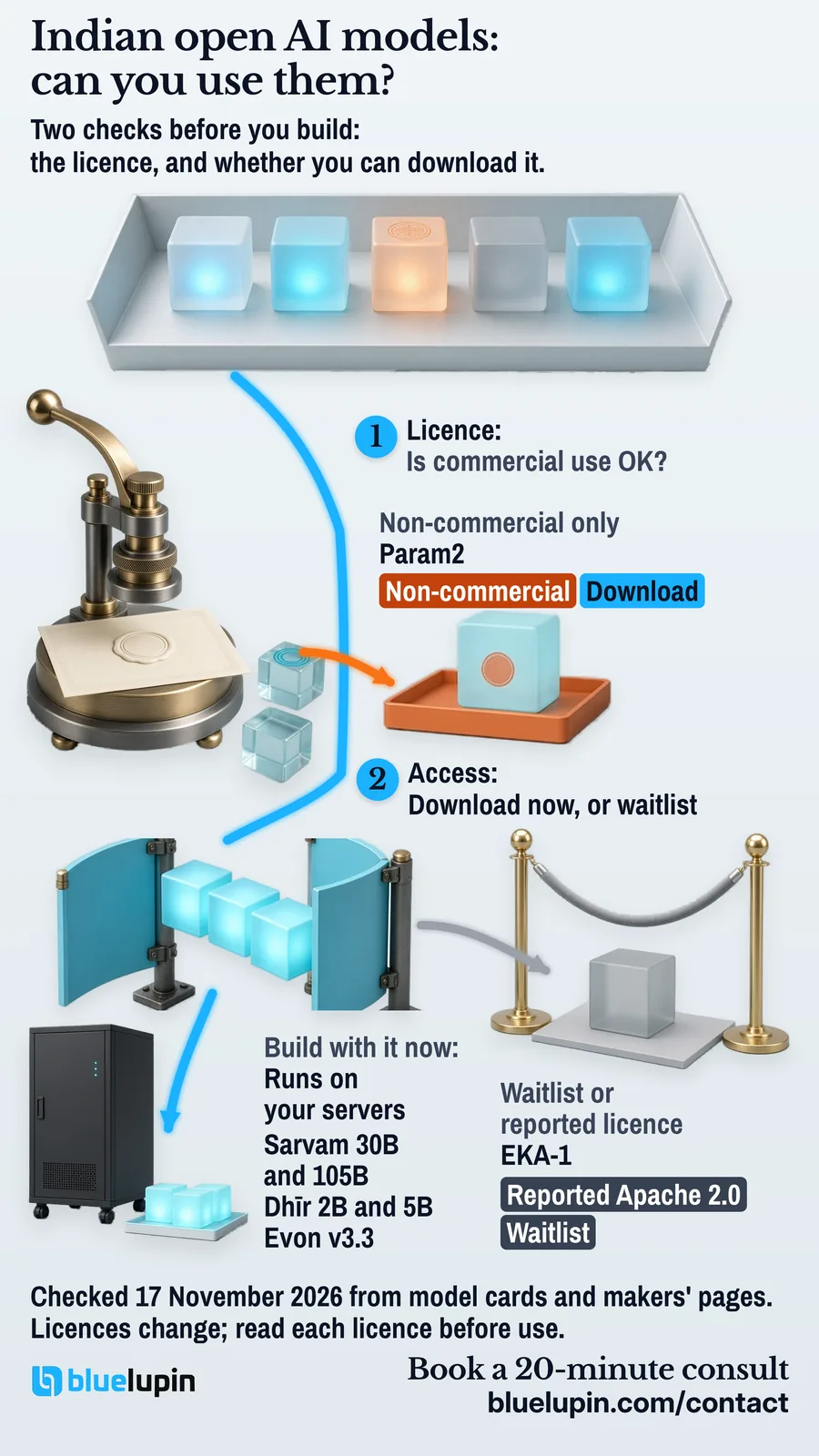
Several Indian open-source AI models are available today. Sarvam 30B and 105B and ZenteiQ’s Dhīr 2B and 5B are released under Apache 2.0, which allows commercial use, with weights you can download from Hugging Face. BharatGen’s Param2 can be downloaded, but its licence covers non-commercial use only. Soket’s EKA-1, released by the IndiaAI Mission on 3 November 2026, is available through a waitlist.
What does “open” mean for an AI model?
Most Indian open-source AI models are really “open weights”. The weights are the files that hold what the model learned. If you can download them, you can run the model on your own servers or in your own cloud account, and your prompts never leave your setup.
Two separate questions follow. First, what does the licence let you do? Apache 2.0 allows commercial use, changes and redistribution, as long as you keep the licence and notices. A non-commercial licence lets you study and test the model, but you need the maker’s permission to use it in a product. Second, can you actually get the files? Some models are listed as open but sit behind an approval step or a waitlist. You need a yes on both.
Which Indian open-source AI models can you get today?
This is what each primary source said when we checked on 23 November 2026.
| Model | Maker | Licence (as published) | Can you download it? | Languages (as stated by the maker) |
|---|---|---|---|---|
| Sarvam 30B, Sarvam 105B | Sarvam AI | Apache 2.0 | Yes, Hugging Face and AIKosh | 22 Indian languages |
| Dhīr 2B, Dhīr 5B | ZenteiQ | Apache 2.0 | Yes, Hugging Face | English and 10 Indian languages |
| Evon v3.3 | Gnani.ai | Apache 2.0, plus NVIDIA’s Nemotron Open Model License for the base model | Yes, Hugging Face | English and 10 Indian languages |
| Param2 17B | BharatGen | BharatGen non-commercial licence | Yes, for non-commercial use | English, Hindi and 21 more Indian languages |
| EKA-1 | Soket AI | Not on the maker’s page; reported as Apache 2.0 on AIKosh | Waitlist, approved by Soket | 22 scheduled Indian languages and English |
Checked 23 November 2026 from the model cards and makers’ pages. Licences can change.
Sarvam 30B and 105B
Sarvam announced the open release of both models on 6 March 2026 under Apache 2.0, with weights on Hugging Face and AIKosh and API access as well (Sarvam). Sarvam says they were trained in India on compute provided under the IndiaAI Mission. The 30B model is built for practical deployment (model card); the 105B model targets harder reasoning work (model card).
Dhīr 2B and 5B
ZenteiQ’s two models came out with EKA-1 on 3 November 2026 (PIB). The cards say Apache 2.0. Dhīr 2B has about 2 billion parameters and is small enough for a laptop or an edge device (Dhīr 2B). Dhīr 5B is sized for a single GPU (Dhīr 5B).
Evon v3.3
Gnani.ai licenses its own work under Apache 2.0. The model is built on NVIDIA’s Nemotron model, so NVIDIA’s licence file ships with it too, and both must travel with any copy you share (model card).
Param2
BharatGen’s 17 billion parameter model is downloadable, and its card says it is “released under the BharatGen non-commercial license” (model card). The licence file limits use to non-commercial research and academic work, and commercial use needs written permission from BharatGen’s legal team (licence). BharatGen’s site says the same: for commercial use, check the model card or write to BharatGen (BharatGen).
EKA-1
The government describes Soket’s 26.3 billion parameter model as “open” (PIB). Today you join a waitlist, and “our team reads each request and approves access” (Soket). News reports say the AIKosh listing shows Apache 2.0 but is marked Restricted (The Tech Bag), and that no weight files had been uploaded on 4 November 2026 (Transclew). We found no EKA-1 files on Soket’s Hugging Face page.
Three checks before you build on one
Licence
Ask three things: can you use it commercially, what credit or notices must you keep, and can you share a changed version? Apache 2.0 answers yes to all three, with notices kept. Param2’s licence answers no to commercial use without permission. Sometimes sources disagree. BharatGen’s smaller Param1 2.9B card shows Apache 2.0 in one place and MIT in another, while BharatGen’s site says its models are for non-commercial use. When that happens, ask the maker in writing. Either way, check the licence file with your legal team before launch.
Access
A Hugging Face listing that isn’t gated means anyone can download the files. AIKosh, the IndiaAI Mission’s platform for models and datasets, marks some items Restricted, which news reports say means the uploader must approve your download (Transclew). A waitlist, like EKA-1’s, means no files until the maker says yes. Soket’s form also asks you to agree that it may use your prompts and responses to improve its models. Read that before you send company data.
Fit
Check three things. Does it cover the languages your users write in? Can you afford the hardware? BharatGen suggests 40 GB or more of GPU memory for Param2 (BharatGen), while Dhīr 2B also runs on CPU in compressed form. Does it handle the tasks you need, such as answering from your documents or calling other tools? Vendor test scores won’t settle this. Test each candidate with your own questions in your own languages. Our post on what each benchmark actually measures explains why.
When does an Indian open model make sense?
This is our view.
It makes sense when data has to stay on your servers or in India and you would rather not send prompts to an outside API. If that is your concern, read our note on what happens to prompts sent to an AI provider.
It makes sense when your users work in Indian languages and a model trained on Indian data does well in your own tests.
It makes sense for offline or low-connectivity settings. The government release describes Dhīr as built for on-premise, offline-capable use (PIB).
A hosted model may suit you better for a quick pilot, for mixed-language work where the hosted model tests better, or if you have no one to run and patch model servers. You also don’t have to pick one. A system can send each task to the model that handles it best, for example an open model for knowledge assistants that answer from your documents and a hosted model elsewhere.
How we choose models for a project
We pick the model for each project based on accuracy, cost, speed and data residency needs. We work with OpenAI GPT models, Anthropic Claude, Meta Llama and other open-source models, and we design to avoid vendor lock-in where possible. You can read more about how we choose AI models for each project.
We built the IndiaAI national AI portal for MeitY. Other teams built the models in this post.
Common questions
Which Indian AI models are open source?
As of 23 November 2026, Sarvam 30B and 105B and ZenteiQ’s Dhīr 2B and 5B carry Apache 2.0 licences with downloadable weights. BharatGen’s Param2 has open weights for non-commercial use. Soket’s EKA-1 is available by waitlist.
Can I use Sarvam’s models in a commercial product?
Yes. Sarvam 30B and 105B are released under Apache 2.0, which allows commercial use if you keep the licence and notices. Weights are on Hugging Face and AIKosh.
Is BharatGen’s Param2 open for commercial use?
No. Param2 is released under the BharatGen non-commercial licence. Commercial use needs written permission from BharatGen.
Can I download EKA-1?
Not directly today. The IndiaAI Mission released EKA-1 on 3 November 2026, and Soket offers access through a waitlist where its team approves each request.
If you’re weighing an Indian open model against a hosted one, we can help you test both on your own questions and languages, then run the one that fits on infrastructure you control. Book a 20-minute consult.