

As businesses work to stay competitive and improve efficiency, AI adoption has become a key priority. With 83% of companies considering AI a top focus in their business plans, it is clear that organizations are aware of its role in streamlining processes, improving decision-making, and automating essential tasks.
Companies that do not integrate AI risk falling behind in a rapidly changing market. In 2025, the emphasis shifts to driving real, measurable value from AI and achieving business growth.
Below, we have explained the top AI innovations for 2025 that will reshape the future of business.
1. Agentic AI: Autonomous Decision-Making
Agentic AI refers to AI systems that autonomously make decisions and perform complex tasks with minimal human oversight.
For example, in an e-commerce business, agentic AI can handle inventory management by autonomously reordering stock based on sales data and predicting future demand. In industries like finance, agentic AI can manage trading decisions in real-time, making fast decisions on investments.
By integrating agentic AI, businesses can automate time-sensitive processes and improve efficiency without constant human intervention.
2. Custom AI App Solutions for Specific Industries
Businesses are shifting from using generic AI models to adopting custom AI solutions that address the unique needs of specific industries.
In healthcare, AI models analyze patient data to identify patterns, improving early diagnosis. In finance, AI detects fraudulent transactions by recognizing unusual behaviors in transaction data.
Custom AI solutions also play a key role in retail, helping companies predict customer preferences, and in logistics, optimizing supply chain management by analyzing shipment data.
AI agents are integral to these custom solutions, performing routine tasks autonomously, such as processing patient records, analyzing financial data for anomalies, or automating customer service interactions.
By integrating AI agents, businesses can streamline operations and achieve higher accuracy in their predictions, offering more precise and reliable results for their industry-specific challenges.
3. CRM-Integrated AI: Streamlining Customer Relationships
CRM-Integrated AI plays a vital role in improving how businesses manage customer interactions and drive loyalty. By incorporating AI into Customer Relationship Management (CRM) software, companies are able to process and analyze customer data in real time.
AI-powered CRM tools analyze purchasing behavior, customer preferences, and interactions to provide personalized recommendations, predict future needs, and identify potential opportunities for upselling or cross-selling.
For example, in retail, AI-integrated CRM systems can predict a customer’s next purchase based on their shopping history and suggest relevant products. In service industries, AI can help businesses track customer satisfaction trends, identify potential issues, and proactively reach out to resolve them.
This not only reduces response times but also leads to a higher level of customer satisfaction. Additionally, integrating AI with CRM systems can automate routine tasks such as scheduling follow-ups and sending reminders, which saves time and allows human agents to focus on more complex issues.
4. Responsible AI and Governance
As AI becomes more integral to business, responsible AI practices are essential. Businesses are creating AI systems that are transparent, ethical, and free from bias. For example, an AI system used in hiring could be designed to ensure that it doesn’t favor one demographic over another.
In finance, responsible AI can help ensure fairness when granting loans. By building ethical AI frameworks, businesses can maintain public trust and comply with evolving regulations, especially in sensitive industries.
5. Multimodal AI: Integrating Multiple Data Types
Multimodal AI systems analyze text, images, audio, and video together. In healthcare, for instance, a multimodal AI system could analyze both a patient’s medical history (text) and medical imaging (images) to provide a more accurate diagnosis.
In marketing, it can analyze customer behavior from multiple touchpoints, such as social media posts, videos, and online shopping data, helping businesses create more personalized and effective campaigns. By using multimodal AI, businesses can gain deeper insights into their operations and customers.
6. AI-Driven Decision Intelligence
AI-driven decision intelligence systems help businesses make data-backed decisions. For example, a retail business can use decision intelligence to predict which products will be in high demand and adjust its inventory accordingly.
Similarly, an AI system might suggest optimal staffing schedules based on historical sales data, preventing under- or over-staffing and improving operational efficiency. By integrating decision intelligence, businesses make faster, smarter decisions with real-time data analysis.
7. AI-Driven Data Analytics: Unlocking Insights for Smarter Decision-Making
AI-Driven Data Analytics helps businesses make data-backed decisions by using AI algorithms to process large datasets, identify patterns, and extract insights. This speeds up data analysis, enabling faster responses to market changes and customer demands.
For example, in the finance sector, AI-driven analytics help detect fraud by analyzing patterns of transactions to flag suspicious activity. In manufacturing, AI can identify inefficiencies in production lines by analyzing machine data, enabling businesses to make timely adjustments that reduce downtime and improve productivity.
Businesses across industries are using AI-driven analytics for predictive modeling, which helps forecast demand trends and optimize supply chains. In marketing, AI can help businesses analyze consumer behavior and design targeted campaigns that result in higher engagement rates. Retailers use data analytics to understand consumer preferences and adjust inventory accordingly, avoiding overstocking or understocking.
Discover the Right AI Solutions for Your Business with Bluelupin
As a top AI development company in India, Bluelupin focuses on providing AI solutions that address the specific needs of your business. Our team works closely with enterprises to identify the most effective AI technologies, whether it’s automating processes with AI agents, integrating diverse data types for deeper insights, or supporting sustainability with smart AI tools.
With years of experience in implementing AI systems, Bluelupin helps businesses solve complex challenges and optimize operations. Explore how our AI solutions can improve your business processes and prepare you for the future. Visit us today to learn more and start your AI journey with a trusted partner.
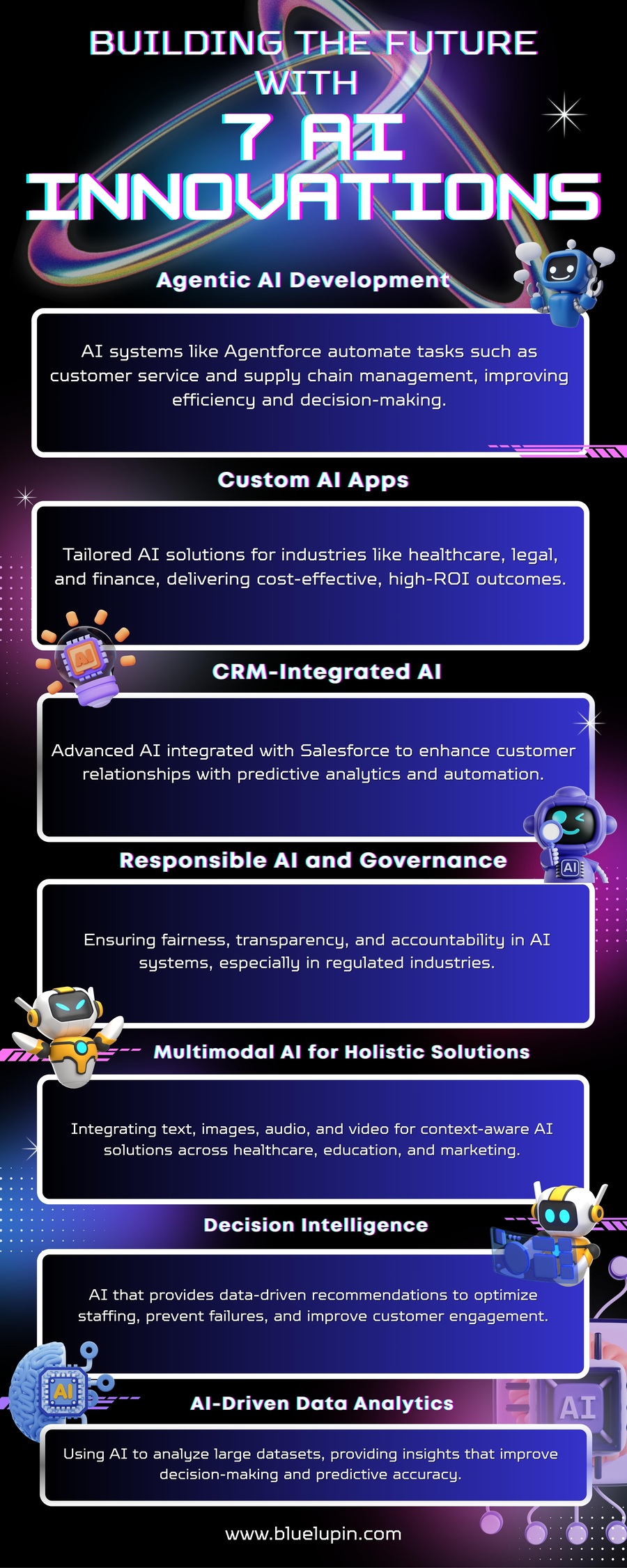
To gain a quick overview of top AI innovations and their contributions in business success in 2025, check out the infographic below.
Conclusion
As AI technologies continue to evolve, the trends discussed above provide businesses with the tools to improve efficiency, drive innovation, and deliver better outcomes. By integrating AI-driven solutions, businesses can automate tasks, make smarter decisions, optimize resource use, and stay competitive. Whether it’s using agentic AI to manage operations or employing multimodal AI for more personalized customer experiences, these innovations are reshaping the future.