
Agent-to-Agent (A2A) Communication: Let the Bots Talk It Out

Introduction
Software agents, also called bots, are computer programs designed to perform tasks autonomously. These agents include chatbots, AI assistants, microservices, and other automated programs that respond to user requests or system triggers.
Traditionally, users interact directly with a single bot or agent to get things done. But there is a growing trend where bots talk to each other to collaborate on tasks. This interaction between bots is known as Agent-to-Agent (A2A) communication.
Developers benefit from A2A by creating modular and scalable systems, where different agents handle specialized jobs and coordinate seamlessly. End users get smoother experiences, like when a customer service bot escalates a complex question to a specialized bot without losing context.
A key component enabling these conversations is the Multi-Channel Protocol (MCP). MCP provides a standard way for agents to exchange messages, share task details, and provide updates across different platforms securely.
In this blog, you’ll learn what A2A communication means, why it matters, how it works, and where it already helps businesses and users today.
Agent-to-Agent (A2A) Communication
What Are Agents or Bots?
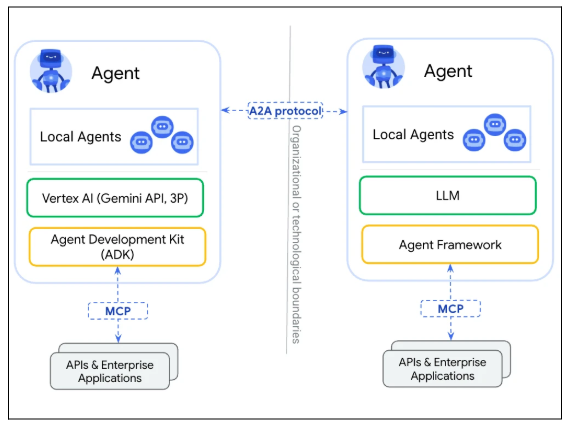
In software terms, an agent is a complex program that often contains multiple smaller, local agents working together to perform tasks. These local agents collaborate inside the main agent to handle different subtasks efficiently.
Agents also integrate advanced AI models or frameworks. For example, some agents use Large Language Models (LLMs), while others might leverage platforms like Vertex AI or specialized frameworks to enhance their capabilities. This layered structure allows agents to combine specialized skills and AI intelligence under one roof.
How Does A2A Communication Differ?
Unlike simple human-to-bot interactions, Agent-to-Agent (A2A) communication involves agents exchanging messages and coordinating actions directly with one another — often across organizational or technological boundaries.
This is made possible through a shared communication standard called the A2A protocol, which lets different agents understand and interact regardless of their underlying technology or who developed them. This protocol enables a dynamic ecosystem where agents collaborate seamlessly beyond single-system limitations.
Common Use Cases of A2A
- Customer service bots handing off conversations smoothly to specialized agents.
- Internet of Things (IoT) devices like smart thermostats and lighting systems coordinating settings.
- Multiple AI agents collaborating in gaming or simulation environments to create complex behaviors.
The Power of Multi-Agent Collaboration
Limitations of Single-Agent Systems
When one agent tries to manage too many responsibilities, it may become complicated and difficult to maintain. It also creates a single point of failure.
Single agents struggle with tasks requiring specialized knowledge or processes that naturally divide into steps.
How Multi-Agent Systems Overcome These Limits
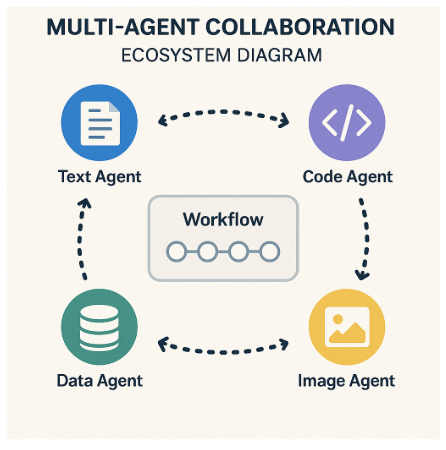
When several agents collaborate, each handles a specific, well-defined task. This modular structure simplifies updates and improvements since changes in one agent don’t disrupt the entire system.
Autonomous AI agents, capable of making decisions independently while coordinating with their peers, are key players in this kind of architecture. If one agent runs into a problem, the others keep working, which boosts the system’s overall reliability.
Benefits of A2A Communication
Agents working together can share knowledge and resources. They negotiate who handles what, and synchronize their actions to avoid conflicts or duplicated work.
This collaboration leads to more efficient workflows and better user experiences.
How Do Agents Actually Talk? Protocols and Technologies Behind A2A
Communication Protocols in Use
Agents communicate using standard protocols familiar to developers:
- REST APIs allow request-response interactions over HTTP.
- WebSockets enable real-time, full-duplex communication for instant updates.
- MQTT is common in IoT for lightweight, publish-subscribe messaging between devices.
These protocols form the technical foundation for agent interactions.
Key Concepts in Agent Communication
- Client Agent: The bot initiating a task or request.
- Remote Agent: The bot receiving and processing the task.
- Messages: Structured data exchanged, including requests, responses, or status updates.
- Tasks: Work delegated from one agent to another.
- Artifacts: Final results or outputs of a task.
To better visualize these concepts, consider the example of a travel agent flowchart. Here, the travel agent (acting as a client agent) communicates with the user (client), processes booking requests, and coordinates subtasks like transport and accommodation. It manages decision points such as risk analysis and proposal approval before executing the final task. This step-by-step flow reflects how agents structure communication and task delegation in A2A systems.

Real-World Applications: Where A2A Communication Makes a Difference
As everyday tools and services get smarter, AI development services are helping bring multiple intelligent agents together to work as a team—making life simpler, faster, and more connected for both businesses and users.
Multi-Bot Customer Service
Many companies deploy multiple chatbots with different specialties. A general assistant bot might handle basic questions, then pass more complex queries to a billing bot or technical support bot without requiring the user to repeat information.
This handoff improves customer satisfaction and reduces response times.
Smart Home Device Coordination
Smart thermostats, lighting systems, and security cameras exchange information to create comfortable and safe environments. For example, when the thermostat detects nobody home, it signals lighting and security systems to adjust accordingly.
Collaborative AI in Gaming and Simulations
Multiple AI agents coordinate to control different characters or units, creating realistic and dynamic environments that respond intelligently to players’ actions.
Robotic Process Automation (RPA) Bots
In business workflows, several RPA bots work in sequence or parallel to automate repetitive tasks such as data entry, approvals, and report generation, communicating their progress and handing off work smoothly.
From Chatbots to Colleagues: How AI Agents Are Becoming Your New Team Members
AI agents are moving beyond simple assistants to become active collaborators. They can take ownership of tasks, communicate progress, and work with other agents just like human team members do.
This shift means users will experience interactions where bots anticipate needs, coordinate efforts, and provide results with little manual supervision.
This concept brings AI closer to everyday workflows and team dynamics, making automation feel less robotic and more like collaboration.
Key Tools and Frameworks Empowering A2A Systems
Multi-Agent Development Platforms
- JADE (Java Agent DEvelopment Framework): An open-source framework for building and managing multi-agent systems.
- Microsoft Bot Framework: Supports building multiple bots that can communicate and be orchestrated together.
Cloud-Native Solutions
Tools like Kubernetes help manage bots as containerized microservices, scaling and coordinating them efficiently across cloud infrastructure.
AI Frameworks Supporting Multi-Agent Coordination
Several AI platforms offer built-in support for multi-agent scenarios, making it easier to build systems where agents negotiate and collaborate intelligently.
A Look at Google ADK: An Open Protocol for Agent Collaboration
Google developed the Agent-to-Agent (A2A) protocol as an open standard to help AI agents communicate across different platforms and technologies.
The protocol enables what Google calls a “multi-agent ecosystem,” where bots from different vendors collaborate on tasks. For example, your assistant bot might delegate a travel booking task to a dedicated booking bot, which sends progress updates back as it works.
The system uses standard web technologies like HTTP, Server-Sent Events (SSE), and JSON, which simplifies integration with existing infrastructures. Each agent provides an “agent card” describing its capabilities and how to interact with it.
Google’s approach aims to make agent communication secure, reliable, and standardized, helping diverse AI systems work together smoothly.
What’s Next for Agent-to-Agent Communication?
Agent communication will expand with trends such as decentralized AI agents that operate independently but stay connected. AI agents will improve in understanding and interacting naturally, supporting more complex workflows.
Integration with edge computing will allow agents to run and communicate closer to where data is generated, reducing delays and improving responsiveness.
Industries like healthcare, finance, and logistics will increasingly rely on these multi-agent systems for automation and decision support.
FAQs
1. What is A2A agent to agent?
A2A (Agent-to-Agent) refers to autonomous software agents communicating directly with each other to share information, delegate tasks, and coordinate workflows without human intervention. This enables complex, multi-agent systems to collaborate efficiently across different platforms and technologies.
2. What is agent-to-agent communication?
Agent-to-agent communication is the exchange of structured messages between autonomous software agents. It allows agents to coordinate actions, negotiate tasks, and share status updates in real time, enabling collaborative problem-solving and automation in distributed systems.
3. What is the agent card in A2A protocol?
An agent card is a public document that describes an agent’s capabilities, supported protocols, and communication endpoints. It acts as a digital profile, enabling client agents to discover how to interact with remote agents effectively within the A2A ecosystem.
4. What is the A2A protocol for agents?
The A2A protocol is an open standard that defines how autonomous agents communicate securely and reliably. It uses web technologies like HTTP and JSON to structure messages, enabling diverse agents from different vendors to interoperate seamlessly in a multi-agent ecosystem.
Conclusion
Agent-to-agent communication offers a framework where software bots work together rather than alone. This approach benefits developers by creating modular, maintainable systems and benefits users through smoother, more capable automated experiences.
By allowing bots to “talk it out,” organizations can build smarter workflows and deliver services with greater reliability and speed.
Developers are encouraged to explore A2A protocols and frameworks in their next projects, and users should look forward to more intelligent, collaborative software assisting them in everyday tasks.
