Your Business is Dying Without Enterprise Software – Here’s Why You Need It NOW!

Running a business today is harder than ever. The competition is fierce, customer expectations are sky-high, and manual processes can no longer keep up with the speed of change. It’s easy to overlook inefficiencies when things seem to be running fine, but the truth is, businesses that rely on outdated systems are losing time, money, and opportunities every day.
If your team is buried in spreadsheets, struggling with disconnected tools, or making decisions based on incomplete data, you’re already at a disadvantage. Enterprise software is no longer a luxury, it’s a necessity for survival and growth.
What’s Holding Your Business Back?
Think about the daily frustrations you and your team face. These issues don’t just slow things down but also cost you money. Every delayed order, every lost customer, and every inefficient process adds up. Without a system to bring everything together, these problems only get worse as your business grows.
- Orders are delayed because inventory tracking isn’t updated in real-time.
- Sales teams are chasing leads with outdated customer information.
- Departments work in silos, leading to miscommunication and duplicated efforts.
- Reports take days to compile, making it hard to respond quickly to market shifts.
- Manual processes eat up valuable time that could be spent on strategic work.
Enterprise Software Solutions Built for Business Growth
Enterprise software isn’t a one-size-fits-all solution. Different types of systems are designed to handle specific challenges, and choosing the right combination depends on the needs of your business.
Here are some of the most widely used enterprise software solutions.
- Enterprise Resource Planning (ERP) – Integrates finance, HR, supply chain, and operations into one system for better efficiency and real-time insights.
- Customer Relationship Management (CRM) – Manages customer interactions, sales pipelines, and service requests, improving customer retention and sales effectiveness.
- Supply Chain Management (SCM) – Tracks inventory, logistics, and supplier relationships to minimize costs and prevent delays.
- Business Intelligence (BI) & Analytics – Gathers and processes data to support informed decision-making and identify business opportunities.
- Human Resource Management Systems (HRMS) – Automates payroll, hiring, employee records, and performance management.
- Enterprise Content Management (ECM) – Organizes, stores, and manages business documents, ensuring easy access and compliance with regulations.
How Enterprise Software Fixes These Problems
Enterprise software connects every part of your business into a single, streamlined system. Instead of juggling multiple tools and constantly switching between platforms, everything from sales and customer service to inventory and finance is accessible in one place.
Here’s how that makes a difference:
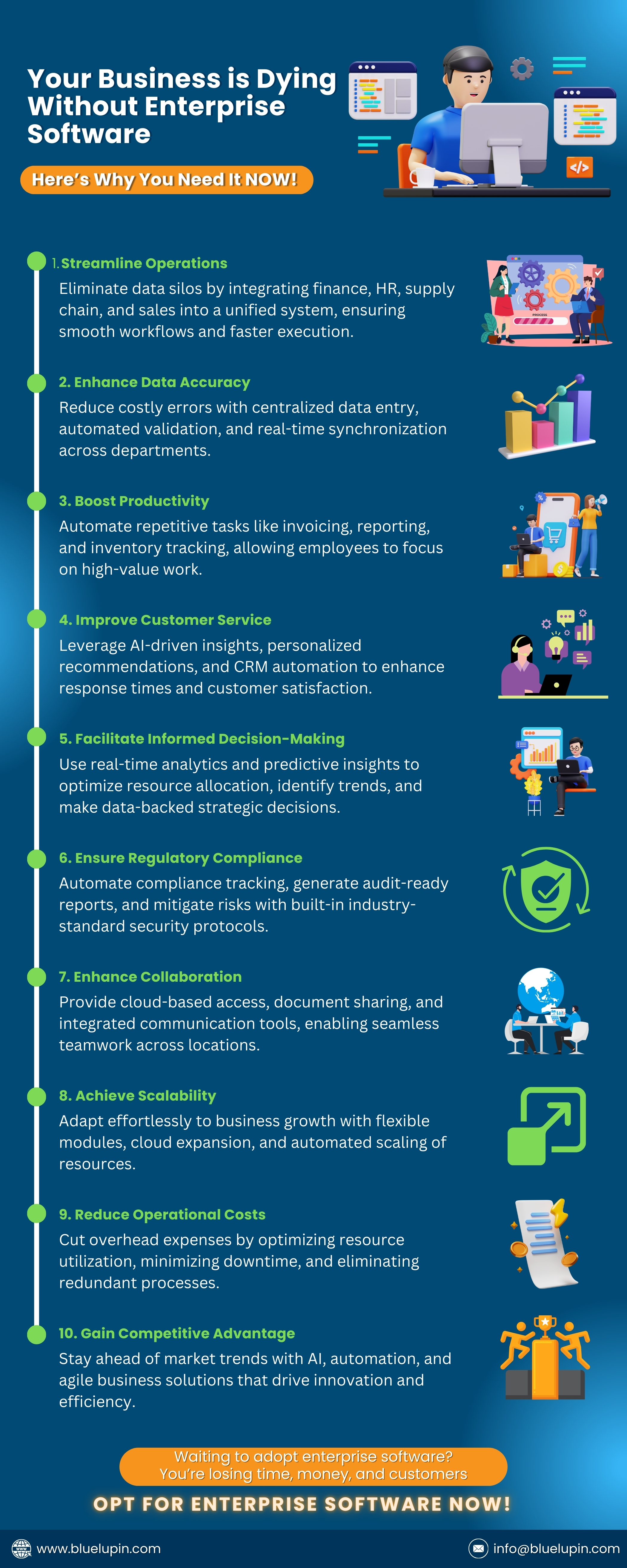
- Efficiency That Saves Time and Money
Automating repetitive tasks like invoicing, payroll, and data entry reduces errors and frees up employees for more valuable work. - Better Customer Management
A centralized CRM (Customer Relationship Management) system keeps track of every interaction, making it easier to personalize service and improve customer loyalty. - Faster, Smarter Decision-Making
Enterprise software provides real-time analytics, so decisions are based on actual data, not guesswork. Whether it’s sales trends, inventory forecasts, or financial reports, you get accurate insights instantly. - Stronger Collaboration Across Teams
When finance, HR, sales, and operations are connected through a unified system, communication improves, and everyone is on the same page. No more wasted time tracking down information. - Scalability Without Chaos
Growth is great—until outdated systems can’t keep up. Enterprise software is built to scale, so whether you’re expanding to new markets or increasing production, operations remain smooth.
The Changing Business Landscape and Why You Need Enterprise Software NOW!
Technology is advancing at an unprecedented rate. Artificial intelligence, automation, and blockchain are transforming industries, and businesses that don’t adapt are being left behind. Companies that embrace enterprise software gain an advantage by integrating these technologies into their operations.
With AI-driven insights, predictive analytics, and process automation, businesses can work faster, minimize risks, and stay ahead of competitors. Without enterprise software, keeping up with these advancements is nearly impossible.
Making the Shift With the Right Software Development Companies
Implementing enterprise software doesn’t have to be overwhelming. The right approach, often adopted by the top software development companies in India, ensures a smooth transition and measurable results. Finding a solution tailored to your business needs can help improve operations, enhance customer experience, and provide better control over your data. By choosing the right tools and strategies, businesses can seamlessly integrate new systems that drive growth and streamline processes.
Want a quick breakdown of why enterprise software is crucial for your business? Check out the infographic below for a snapshot of the key takeaways.