
RBI cyber security rules for payment operators and vendors
RBI's November 2026 cyber security rules for payment system operators: who they cover, what vendors must provide, and what to check first.


A made-up example. A software vendor for an Indian payment company receives a revised agreement asking for source code or an escrow, a developer certificate after every code change, and the right to audit. That is what the RBI cyber security rules for payment system operators look like from the vendor side (RBI Master Directions, 5 November 2026).
Based on the RBI Master Directions dated 5 November 2026, checked 15 November 2026. This is a plain-language summary and isn’t legal advice, so read the RBI text with your compliance team.
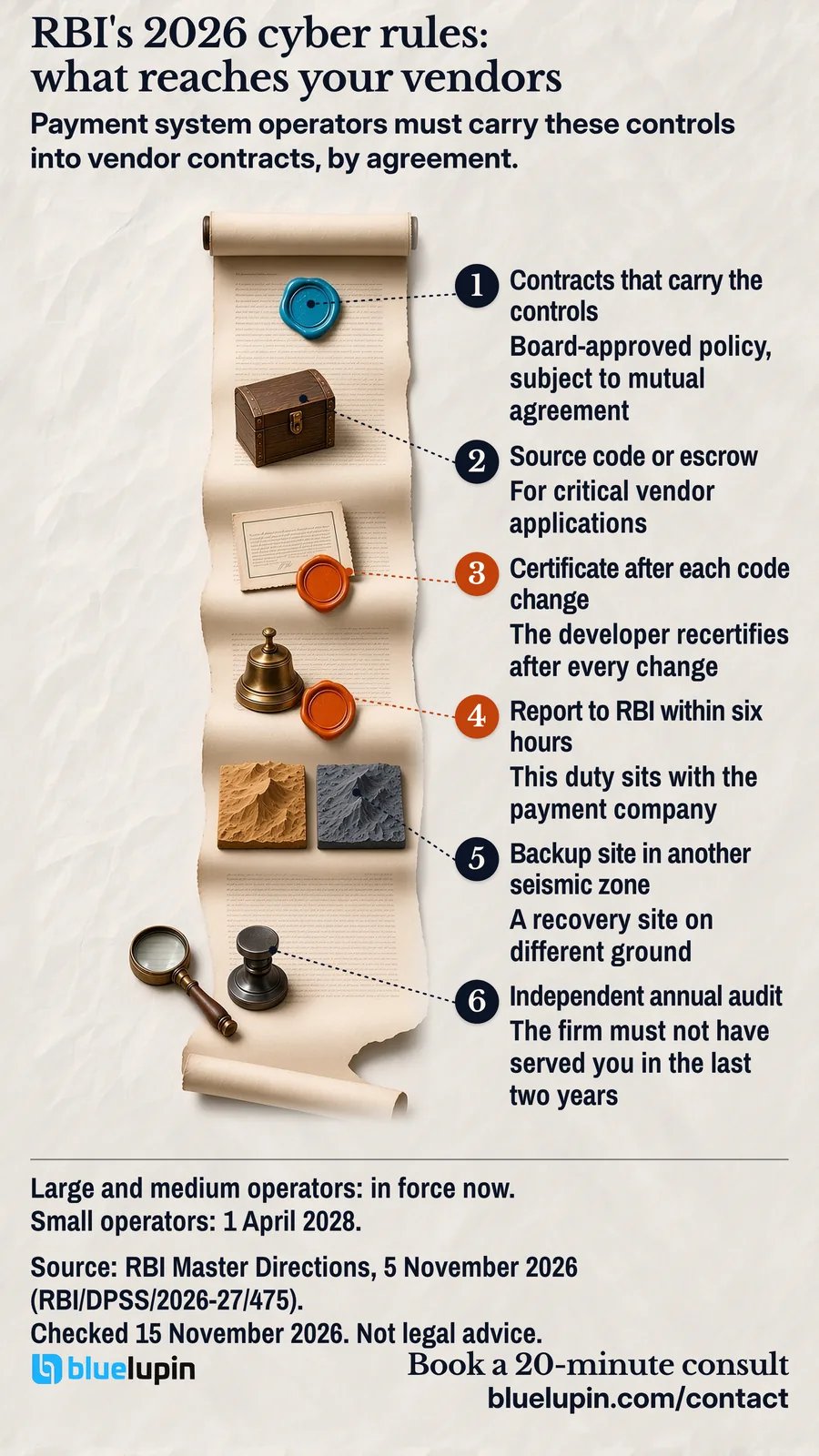
RBI’s Master Directions of 5 November 2026 require non-bank payment system operators to run Board-led cyber governance, report serious incidents to RBI within six hours, file an annual system audit, keep a disaster recovery site in another seismic zone, and hold source code or escrow for critical vendor apps. Operators must also extend these controls to their vendors, subject to mutual agreement.
What did RBI issue on 5 November 2026?
On 5 November 2026, RBI published consolidated cyber security rules for payment system operators (RBI/DPSS/2026-27/475). It folds the 30 July 2024 Master Directions with cyber security controls for third-party ATM switch providers (31 December 2019) and the scope of system audits (10 January 2020). Six circulars from 2009 to 2020 are repealed (RBI cover letter and paragraph 58).
Issued under the Payment and Settlement Systems Act, 2007. Existing instructions for cards, prepaid instruments and mobile banking still apply.
Much of this rulebook already existed in July 2024. Business Standard notes that the six-hour reporting window and the 12-hour cooling period are retained.
Which payment companies must comply, and when?
These directions apply to all authorised non-bank payment system operators. Timing depends on size (paragraph 3 and footnotes 1 to 3).
| Category | Who (RBI list) | In force |
|---|---|---|
| Large | NPCI, NPCI Bharat BillPay, CCIL, card networks, payment aggregators, large PPI (wallet) issuers, BBPOUs, TReDS operators, non-bank ATM networks, white label ATM operators | From the day RBI placed the directions on its website (the document is dated 5 November 2026) |
| Medium | Inbound cross-border money transfer operators, medium PPI issuers | Same as large |
| Small | Small PPI issuers, instant money transfer operators | 1 April 2028 |
Wallet (PPI) issuers are split by size, and one that moves up a category gets one year from the recategorisation to comply.
What does it ask of your vendors?
Contracts that carry the controls
Operators must ensure that unregulated partners in their payments ecosystem (payment gateways, third-party service providers, vendors, ATM switch providers) follow the directions, subject to mutual agreement, under a Board-approved policy (paragraph 5). Vendors in critical processes must give certified assurance from an independent auditor and follow the rules on where data is stored and processed (paragraph 19).
Source code, escrow and certificates
For critical vendor applications, the payment company must obtain the source code, or set up an escrow if it cannot, so services can continue (paragraph 17(c)). If the payment company does not own the source code, the developer must certify that the application has no vulnerabilities, malware or covert channels, and must recertify after each source code change (paragraph 18(b)).
Testing before every critical release
All applications need annual security testing (code review, vulnerability assessment and penetration testing) in authenticated mode (paragraph 18(a)). Deploying or redeploying services that support critical functions must wait for a security audit and for findings to be fixed (paragraph 18(d)).
Audit independence
The payment company must have its annual system audit done by a CERT-In empanelled auditor, a CISA, or an ICAI DISA holder (paragraph 36). The audit firm, and its sister concerns, must not have provided any service to the payment company in the last two financial years (paragraph 37). We structure projects so code and accounts stay with you.
Which rules turn into build work?
The table below maps selected clauses to the product work they usually create. The last column is our reading of that work.
| RBI clause | What it says, in brief | Build task | Usually involves (our view) |
|---|---|---|---|
| 31(c) | Bind the app to the device and SIM; re-bind after idle | Device and SIM binding, plus a re-bind flow | App team |
| 31(g) | 12-hour cooling period after a mobile or email change | Hold online payments for 12 hours after a contact change | App and backend team |
| 31(f) | Detect remote access apps where possible; block payments while active | Remote access detection in the app | App team |
| 27(a) | Multi-factor authentication on electronic debits, unless relaxed | A second factor on every debit flow | Backend team |
| 30 | Customers can flag a fraudulent transaction in the app or site | A “Report fraud” flow that notifies the issuer | App and backend team |
| 27(e) | Logs that identify user, action and parameters; keep five years | Log design and retention | Backend and platform team |
| 24 | API authentication, integrity, availability, anomaly detection | API gateway and monitoring | Backend and platform team |
| 22(d) | Payment company reports unusual incidents to RBI within 6 hours; cyber incidents to CERT-In | Alerting, an escalation runbook, vendor notice terms | Security, operations, vendors |
| 23 | DR in another seismic zone; half-yearly drills; aim for almost no data loss | DR region, replication and a drill plan | Platform team, cloud provider |
| 26 | Cloud policy covering data localisation; annual provider audit | Region and residency settings, audit evidence | Platform team, cloud provider |
| 17(c), 18(b) | Source code or escrow; developer certificate on code changes if code is not owned | Handover or escrow terms, release certificates | Vendors |
Small operators start these controls on 1 April 2028 (paragraph 3). For API security under paragraph 24, see our note on AI-driven attacks on payment APIs. AI in fraud monitoring or support flows sits inside the same audit-log, access and testing rules (AI systems built with audit trails).
What should you check this quarter?
These are our recommendations.
- List every vendor in a critical process and check which contracts carry the RBI controls under the Board-approved policy.
- For each critical third-party application: do you hold the source code, an escrow arrangement, or neither?
- Map who detects an unusual incident and how fast they tell you. The six-hour report to RBI is the payment company’s duty (paragraph 22(d)). In our reading, vendors need contract terms that give you enough notice to file on time.
- Confirm your disaster recovery site is in a different seismic zone from the primary data centre, and the date of your last half-yearly drill (paragraph 23).
- Check that your system auditor (and any sister concern) has not served you in the last two financial years, and note the filing date: 1 June for April to March years, or 1 March for calendar years (paragraphs 36 and 37). Close open audit observations within three months (paragraph 41).
They are close to the evidence auditors and boards ask for.
Common questions
Do RBI’s rules apply to software vendors?
Not directly. Operators must ensure their unregulated partners, such as gateways and vendors, follow the directions, subject to mutual agreement, so vendors meet them through contracts. Vendors in critical processes need independent auditor assurance (paragraphs 5 and 19).
How fast must a payment company report a cyber incident to RBI?
Within six hours of detection, in RBI’s incident format, for unusual incidents such as cyber attacks, critical outages, internal fraud and settlement delays. Cyber security incidents also go to CERT-In (paragraph 22(d)).
Do payment companies need the source code of vendor software?
For critical applications bought from vendors, yes, or an escrow if the code cannot be obtained. If the payment company does not own the code, the developer must certify the application after each source code change (paragraphs 17(c) and 18(b)).
When is the system audit report due?
Annually, within two months of the financial year close: by 1 June for April to March years, and by 1 March for calendar years (paragraph 36).
If your payment product or vendor contracts need to catch up with these rules, we can help on the build side: code handover, change records, testing before release, disaster recovery and audit logs. That work sits in Bluelupin’s FinTech app development practice, whose work includes the Niwish digital gold platform and digital products for Vasundhara Diamond Roof. Book a 20-minute consult.