Stop Wasting Money on Salesforce! Do THIS to Actually Get Results

Introduction
Salesforce is a powerful platform that, when implemented effectively, can streamline business operations, improve customer relationships, and accelerate growth. However, many companies invest heavily in Salesforce development and Salesforce integration without seeing the expected ROI. Instead of driving efficiency, they end up with a complex, underutilized system that consumes resources without delivering results.
The problem isn’t Salesforce itself—it’s the lack of a strategic approach to customization, automation, and system integration. Without a scalable architecture and optimized workflows, businesses struggle with inefficient processes, poor user adoption, and mounting operational costs.
If your Salesforce investment isn’t yielding the desired outcomes, it’s time to evaluate where things are going wrong and how to unlock its full potential with smart development and integration strategies.
Why Most Businesses Struggle with Salesforce
One of the biggest mistakes companies make is diving into Salesforce development without a well-defined scalability strategy. This leads to bloated customizations, fragmented workflows, and inefficient data management. Over time, these issues make the system harder to maintain, upgrade, and scale, ultimately driving up costs.
Another major challenge is underutilization of automation and AI-driven features. Many businesses continue to rely on manual processes instead of leveraging Einstein AI, Flow Orchestrator, and Apex automation to streamline operations. Additionally, poor Salesforce integration with ERP, marketing automation, and customer support platforms results in data silos and a lack of a unified customer view, reducing overall efficiency.
Security and compliance issues also play a critical role. Without proper role-based access controls, field-level security, and GDPR-compliant measures, businesses risk data breaches and regulatory penalties. A lack of proactive security planning often leads to reactive fixes, increasing costs in the long run.
How to Optimize Salesforce for Maximum ROI
To make Salesforce a growth enabler rather than a cost burden, businesses must focus on scalability, automation, seamless integration, and security.
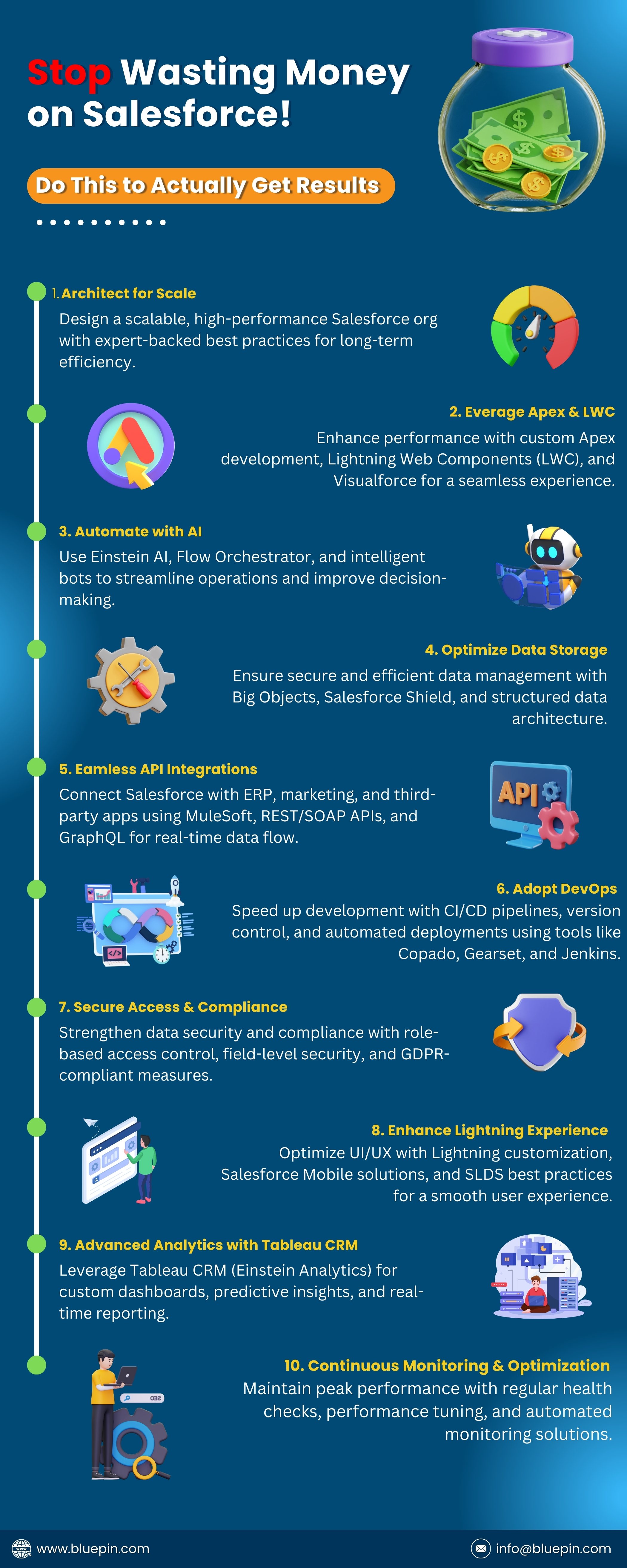
- Leverage Advanced Salesforce Development: Use Apex, Lightning Web Components (LWC), and Visualforce to create efficient, scalable applications that enhance performance and user experience.
- Streamline Data Architecture: Implement Big Objects and Salesforce Shield for secure, high-speed data storage and structured data flow across all business functions.
- Enhance Salesforce Integration: Connect ERP, marketing automation, and third-party applications with MuleSoft, REST/SOAP APIs, and GraphQL to ensure real-time data synchronization and a 360-degree view of operations.
- Adopt DevOps for Agile Deployment: Implement CI/CD pipelines, version control, and automated testing using tools like Copado, Gearset, and Jenkins to accelerate releases without system downtime.
- Leverage AI-Driven Automation: Automate workflows with Einstein AI and Flow Orchestrator, enabling intelligent decision-making and process efficiency.
- Improve Security & Compliance: Strengthen data governance with field-level encryption, role-based access control, and GDPR-compliant configurations to protect sensitive business data.
📌 Check out our infographic below for a step-by-step guide on optimizing Salesforce and achieving real results!
Salesforce is a powerful investment—but only if it’s used strategically. By optimizing architecture, automating key processes, ensuring seamless Salesforce integration, and strengthening security, businesses can maximize efficiency, cut unnecessary costs, and drive real growth.