
Audit trails for AI decisions: what to record so you can answer “why did it do that?”
An AI audit trail shows why your AI did something. What to record for each AI decision, how long India and the EU expect logs kept, and how to seal them.


Checked 26 November 2026.
Say a customer writes: “Your assistant told me my claim was rejected. Why?” Your team opens the chat transcript, the provider dashboard and a log file. Nothing ties them together, and nobody can say which model version answered or whether a person approved it.
An AI audit trail is the record that lets you answer “why did it do that?” months later. For every AI decision, write down who or what triggered it, what the model was shown, which model and prompt version ran, which tools and human approvals fired, and what went out. Keep it long enough for your rules, and make silent edits detectable.
This post covers your own record of each decision. Approval design is in approval gates for AI agents, and evidence is in DPDP proof packs.
What an AI audit trail is
An ordinary app log answers “what broke this afternoon”. An audit trail answers “what happened on 3 March and who allowed it”. It is written at the moment of decision, ties a person or system to a model version and an outcome, and is kept as evidence.
Many teams have no such record. RBI’s committee report on responsible and ethical AI (13 August 2025) found that of 127 regulated entities that reported using AI, only 18% maintained audit logs.
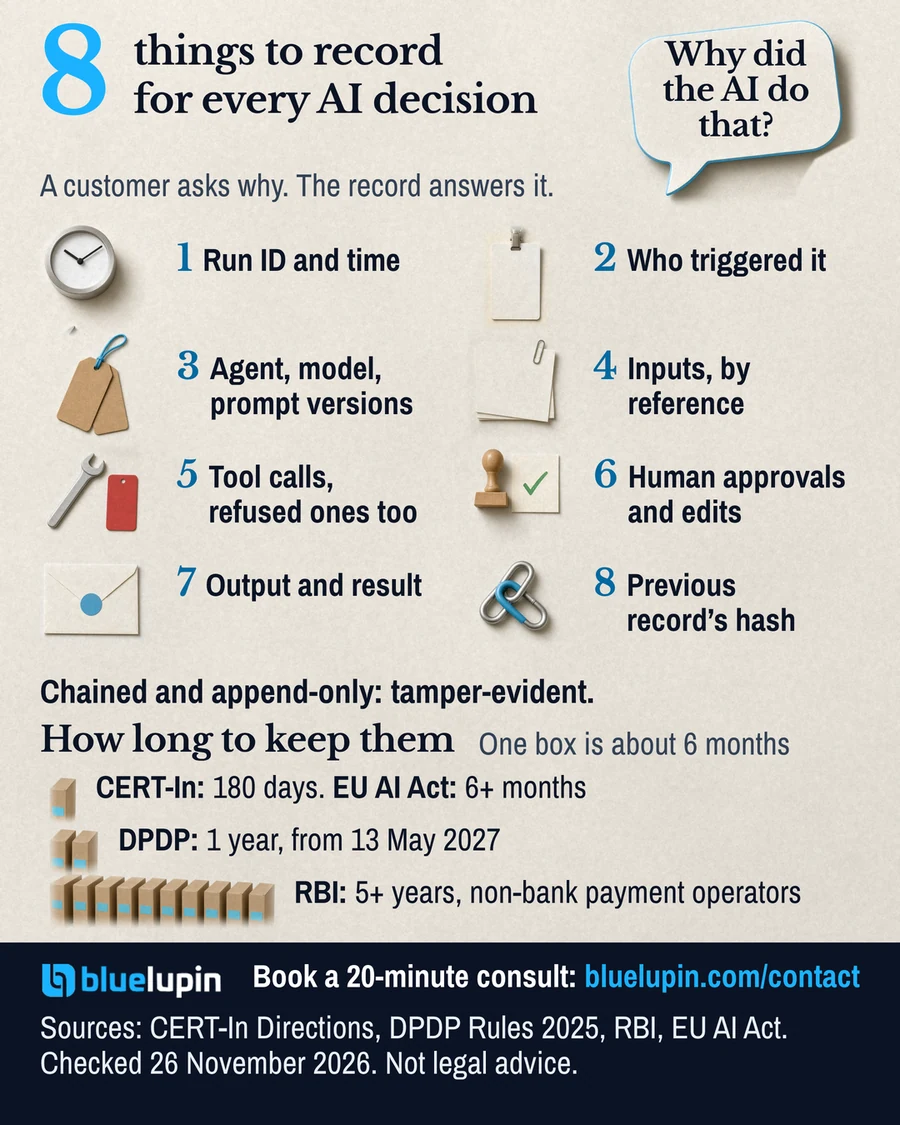
What to record for every AI decision
Our checklist:
| What to record | Why you need it | What to redact or reference |
|---|---|---|
| Run ID and UTC time | Joins every step on a timeline | Nothing |
| Who or what triggered it, and for whom | Shows who started it | Internal user ID |
| Agent name and version | Shows which release decided | Nothing |
| Model name returned by the provider, prompt and policy version | Explains a decision after models change | Never store API keys |
| Inputs and retrieved sources | Shows what the model saw | Document IDs, versions and hashes |
| Tool calls and results, including refused calls | Shows what the AI did and was stopped from doing | Mask account numbers |
| Approvals, rejections and human edits | Shows who allowed the action | Reviewer ID |
| Output, destination and result | Shows what reached the customer | Reference to stored output |
| Previous record’s hash | Makes later edits detectable | Nothing |
Providers update models and your team edits prompts, so exact versions let you reproduce a decision. Record denials too: an auditor often asks what the AI tried and was stopped from doing. Our post on agent tool access covers deny logs.
What one record looks like
A fictional record:
{
  "run_id": "run-8f2c",
  "time_utc": "2026-03-03T09:41:07Z",
  "triggered_by": "user-1042",
  "agent_version": "claims-helper-1.4",
  "model_returned": "provider-model-2026-10",
  "prompt_version": "claims-prompt-12",
  "tool_call": {"name": "get_claim", "args_hash": "a91f"},
  "approval": {"reviewer": "staff-17", "decision": "approved"},
  "output_ref": "out-5530",
  "prev_hash": "c47d"
}
It holds references, so personal data stays out.
How long to keep AI logs in India
No Indian law sets AI-specific log rules yet. CERT-In’s November 2026 AI audit guidelines expect 180-day logs across AI components, but they are guidance and carry no legal mandate of their own. Several general rules may set floors.
| Rule | Who it covers | How long | From when |
|---|---|---|---|
| CERT-In Directions, 28 April 2022 | Service providers, intermediaries, data centers, bodies corporate, government | Rolling 180 days | In force |
| DPDP Rules 2025, Rule 6(1)(e) | Data Fiduciaries | One year, unless another law needs more | 13 May 2027 |
| DPDP Rules 2025, Rule 8(3) | Data Fiduciaries (covering their processors) | Minimum one year, then erase unless another law needs more | 13 May 2027 |
| RBI Master Directions, 5 November 2026, para 27(e) | Non-bank payment system operators | At least five years | Now; small operators 1 April 2028 |
| RBI IT Governance Master Direction 2023, para 15 | Banks, NBFCs, other regulated entities | No fixed period | 1 April 2024 |
| EU AI Act, Articles 19 and 26(6) | Providers and deployers of high-risk systems | At least six months | 2 December 2027 (Annex III) |
CERT-In’s 28 April 2022 Directions ask for ICT system logs for a rolling 180 days within the Indian jurisdiction, and CERT-In’s FAQ (Q35) allows storage outside India if logs can be produced in reasonable time. CERT-In’s 2022 Directions already treat attacks on AI and ML systems as reportable, and its AI Security Auditing Guidelines (4 November 2026) expect logs from AI components to be kept for 180 days. The DPDP Rules 2025 add two one-year rules from 13 May 2027.
RBI’s 2023 IT Governance Master Direction requires audit trails with no fixed period. The five-year rule applies only to non-bank payment system operators.
In the EU, Article 12 of the AI Act binds high-risk systems only, such as hiring or credit. Deployers keep logs for at least six months under Article 26(6), and providers under Article 19. Regulation (EU) 2026/1744 moved the start to 2 December 2027 for Annex III systems and 2 August 2028 for AI inside regulated products.
Our practice: set retention per log type to the longest rule that applies to you, and have the log store enforce it.
We are engineers, so treat this as technical guidance and check legal questions with your counsel.
Keep personal data out of the trail
The trail must explain decisions, and DPDP expects you to minimize personal data. Redact or tokenize before writing, store document IDs and hashes, and keep full prompts only where needed, in a separate tighter store.
Our PII tokenization post shows how tokens work, and the Gemini API retention post covers the provider’s copy.
Make silent edits detectable
- Sync the clock. Use NIC or NPL time, or a source traceable to them, and store UTC.
- Append only. The app writes with a credential that cannot update or delete.
- Separate place. Keep the audit store in another account from the app.
- Hash chaining. Each record carries a fingerprint of the one before it, so an edit breaks the chain.
- Retention lock. Cloud object lock refuses deletes until the period ends.
This makes tampering visible. Someone holding the signing key or full storage access can still rewrite history, so protect both.
Where to start this month
Pick one AI feature that can change money, a customer record or a public answer. Use the table above as its schema and write to one append-only store. Then run a drill: pick a random decision and answer “why did it do that?” from the trail alone in 15 minutes. The gap is your next task.
Add one inventory line per AI feature: owner, model, prompt version, retention. NIST AI RMF 1.0 (voluntary) asks for an inventory in GOVERN 1.6. A logging standard, ISO/IEC 24970, is still under publication. A SIEM can come later.
Common questions
What is an AI audit trail? A record written at the moment of each AI decision. It shows who or what triggered it, what the model was shown, which model and prompt version ran, which tools and approvals were involved, and what went out.
What should an AI audit trail include? A run ID and time, the trigger, the model and prompt version, the inputs, every tool call including refused ones, every human approval or edit, and the final output. Store references and hashes instead of personal data.
How long should we keep AI logs in India? No Indian law sets AI-specific log rules yet. CERT-In’s November 2026 AI audit guidelines expect 180-day logs across AI components, but they are guidance and carry no legal mandate of their own. CERT-In asks for ICT system logs for a rolling 180 days. From 13 May 2027, the DPDP Rules ask for one year of security and processing logs. RBI asks payment system operators for five years of audit logs.
Does the EU AI Act require logs for every AI system? No. Article 12 applies to high-risk AI systems, such as those used in hiring or credit. Providers and deployers keep logs for at least six months, from 2 December 2027 for Annex III uses.
Should we store full prompts and responses? Only where you need them to explain a decision. Redact or tokenize personal data first, keep IDs and hashes instead of copies, and put full text in a separate store.
How do we stop people from quietly editing AI logs? Sync clocks, write to an append-only store in a separate account, chain records with hashes, and use a retention lock. Edits become detectable, though whoever holds the signing key can still rewrite records.
Do NIST AI RMF or ISO/IEC 42001 prescribe a log format? No. NIST AI RMF is voluntary guidance, and ISO/IEC 42001 sets requirements for an AI management system. Neither gives a field-by-field schema.
Bluelupin builds governance controls into every AI project: audit logs, role-based approvals and guardrails on what each agent can do. See our AI solutions.